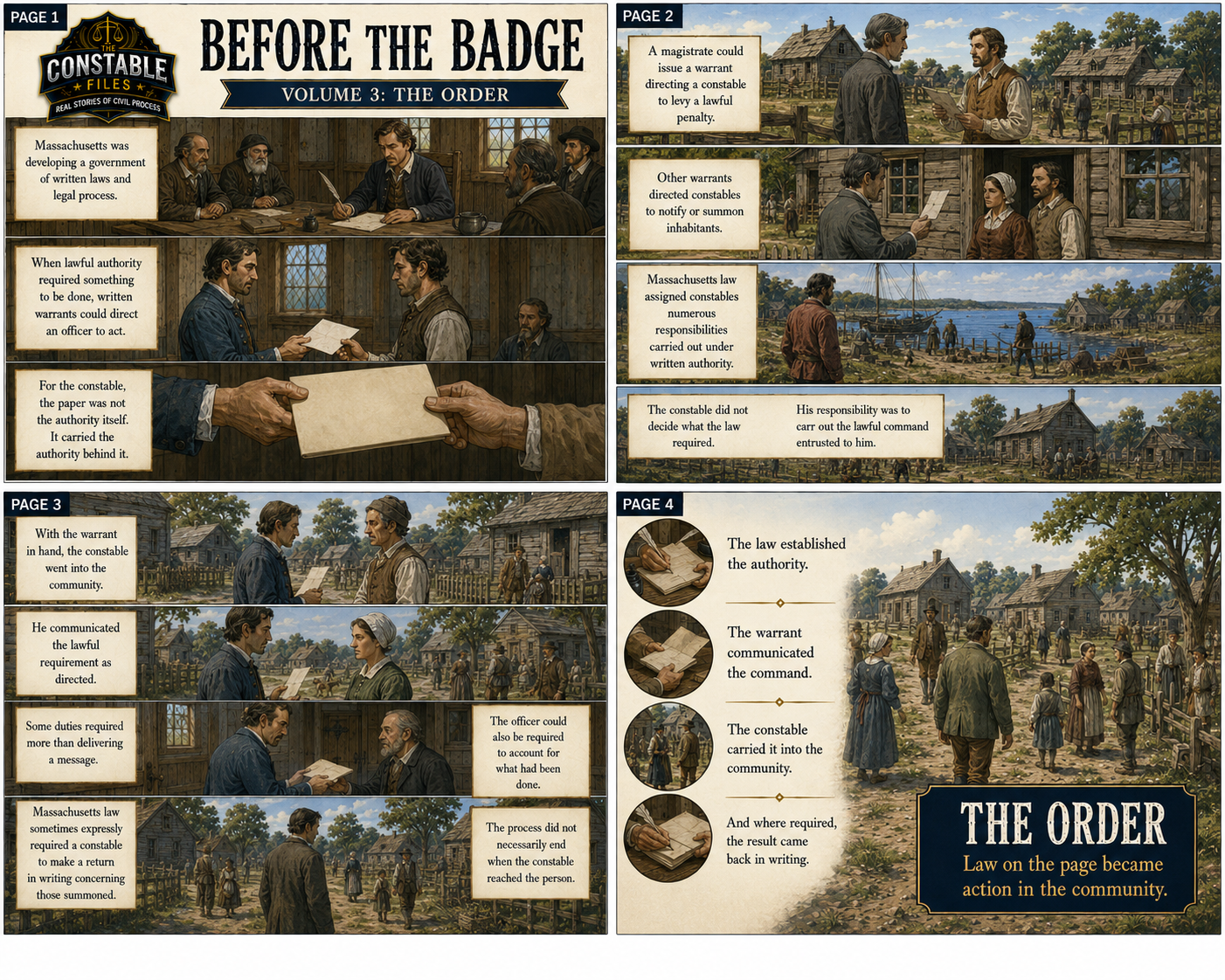
The law could be written. Someone still had to carry it out. In early Massachusetts, written warrants connected legal authority with action in the community. Constables were among the public officers entrusted with receiving those commands, carrying out the duties assigned to them, and, in some cases, reporting the result. In Volume 3: The Order, follow the written process from the hands of government into the community and discover an early responsibility that would remain closely associated with the constable's office for centuries. Law on the page became action in the community.
Laws and decisions meant little if they remained only on paper. As government developed in colonial Massachusetts, written warrants provided a means of directing public officers to carry lawful authority into the community.
Volume 3 of Before the Badge explores the constable's role in that process. Colonial Massachusetts laws contain examples of warrants directing constables to perform specific duties, including notifying or summoning inhabitants and carrying out other legally assigned responsibilities.
The constable did not determine what the law required. He acted under the authority entrusted to his office and the written process placed in his hands. In some circumstances, the responsibility continued afterward, with Massachusetts law requiring a written return or other accounting of what had been done.
The Order examines this important connection between law, written process, the constable, and the community without imposing modern service-of-process procedures on the seventeenth century.
It also establishes an important theme that will continue throughout the history of the office: public authority often depends upon someone being responsible for carrying it into effect.
The law established the authority. The warrant communicated the command. The constable carried it into the community.
Before the Badge is a historical mini-series from The Constable Files, exploring the history and evolution of the Massachusetts constable.