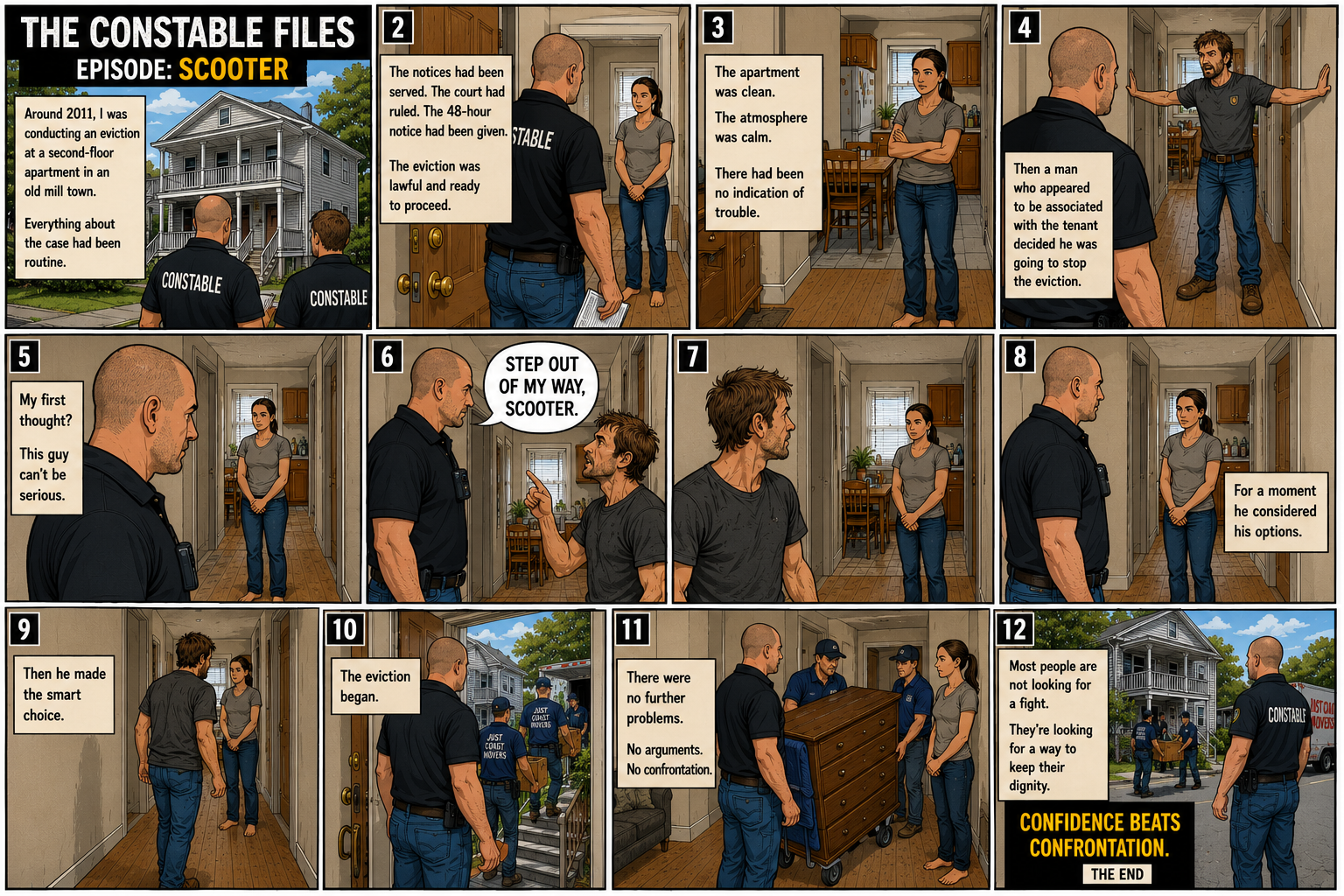
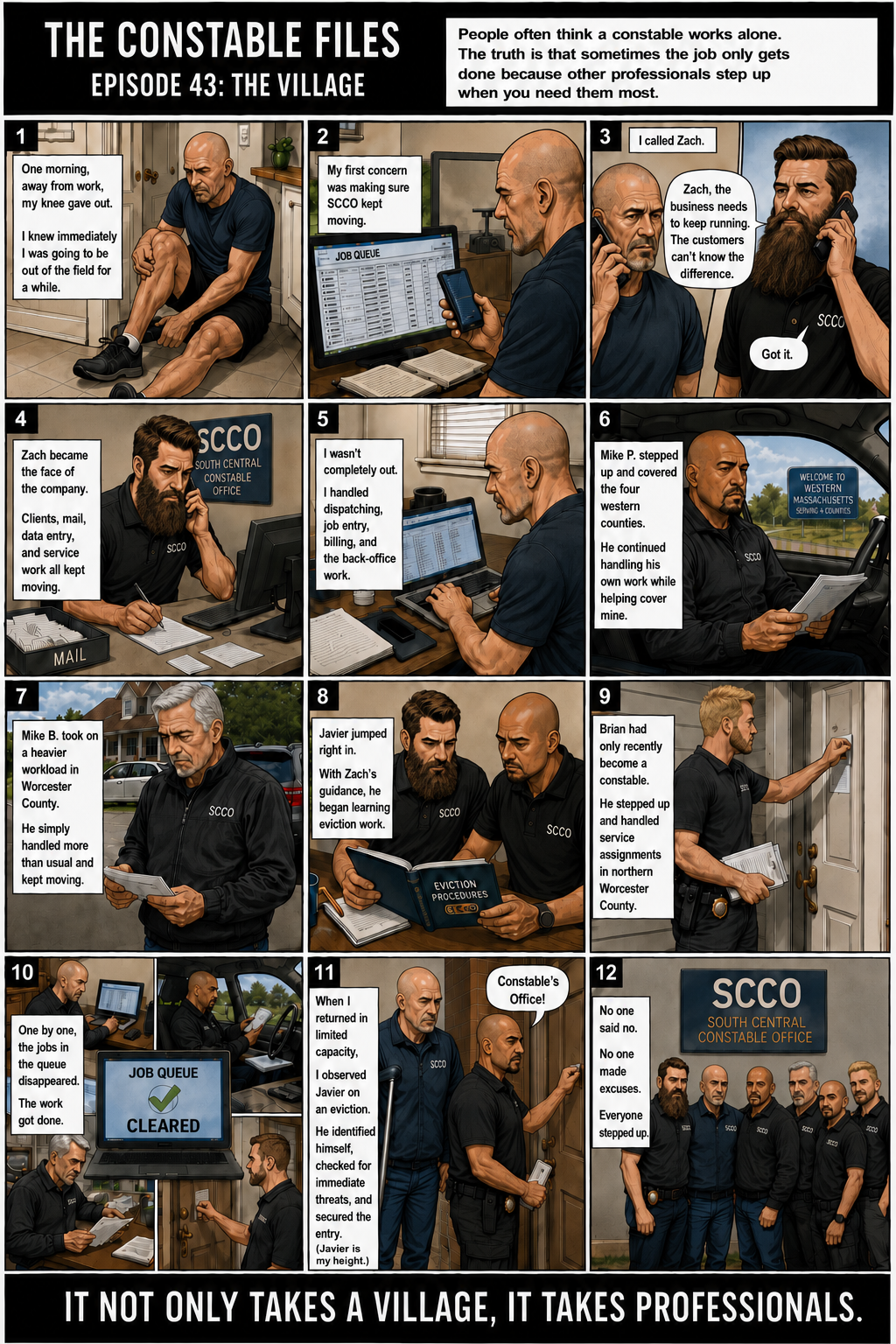
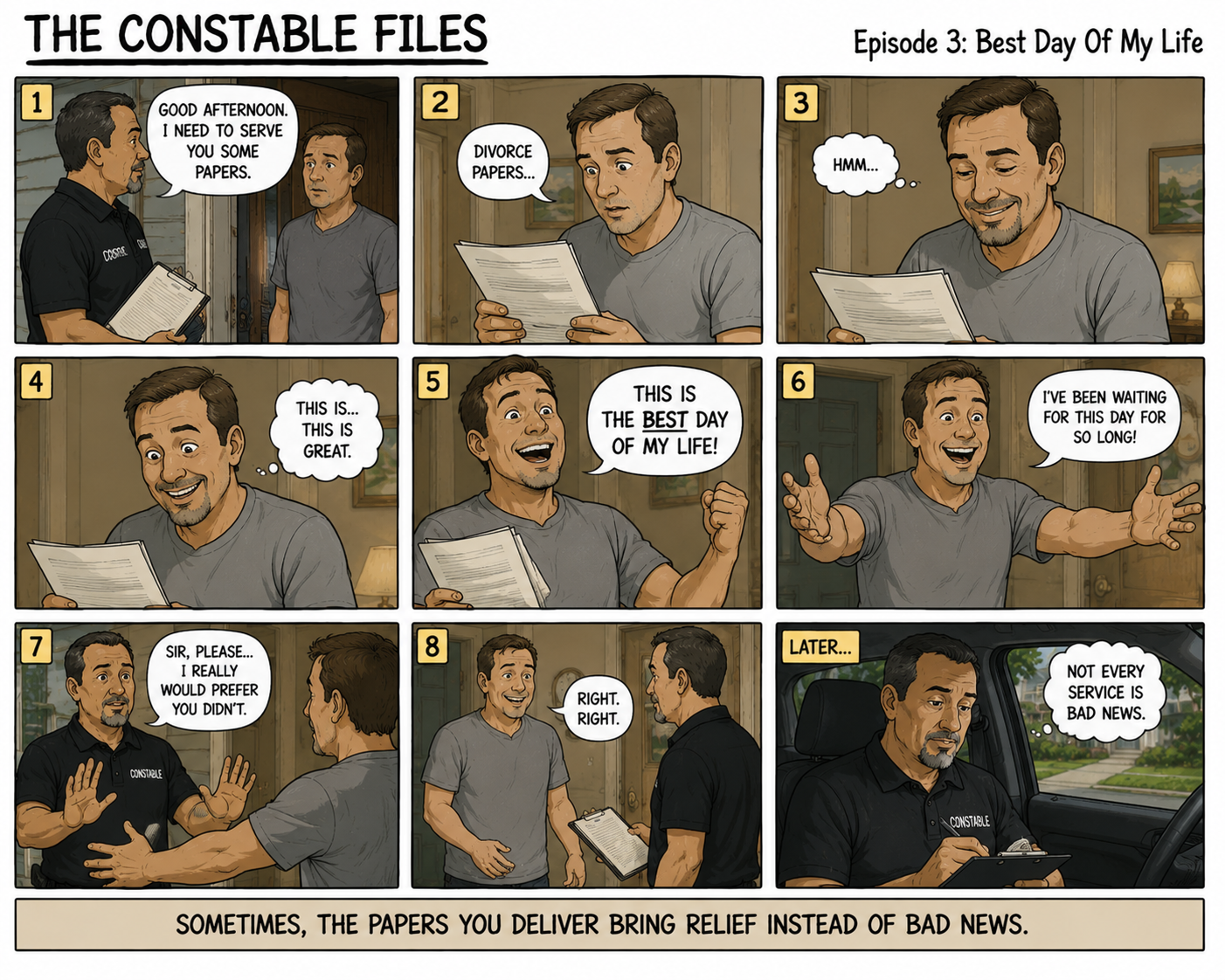
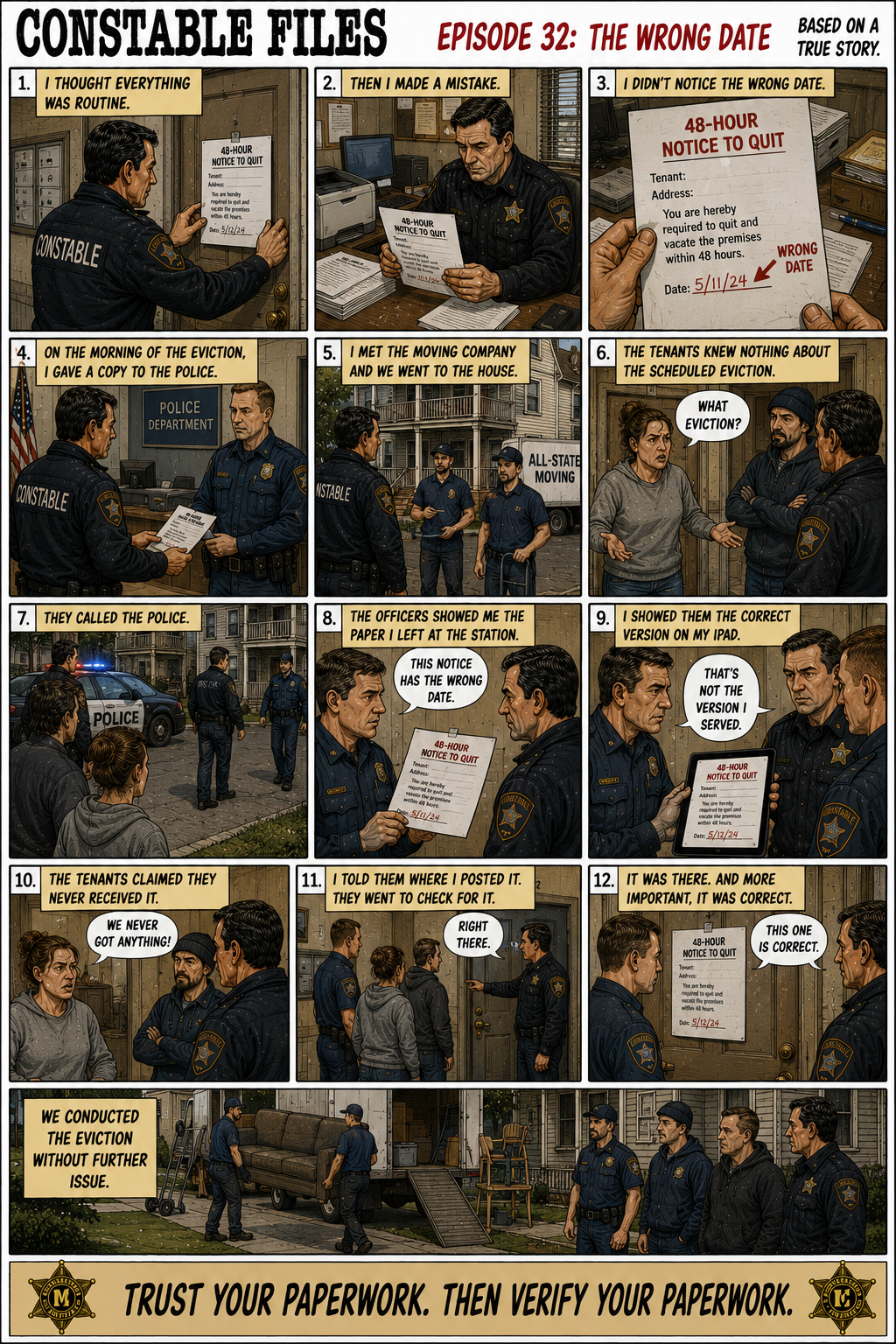
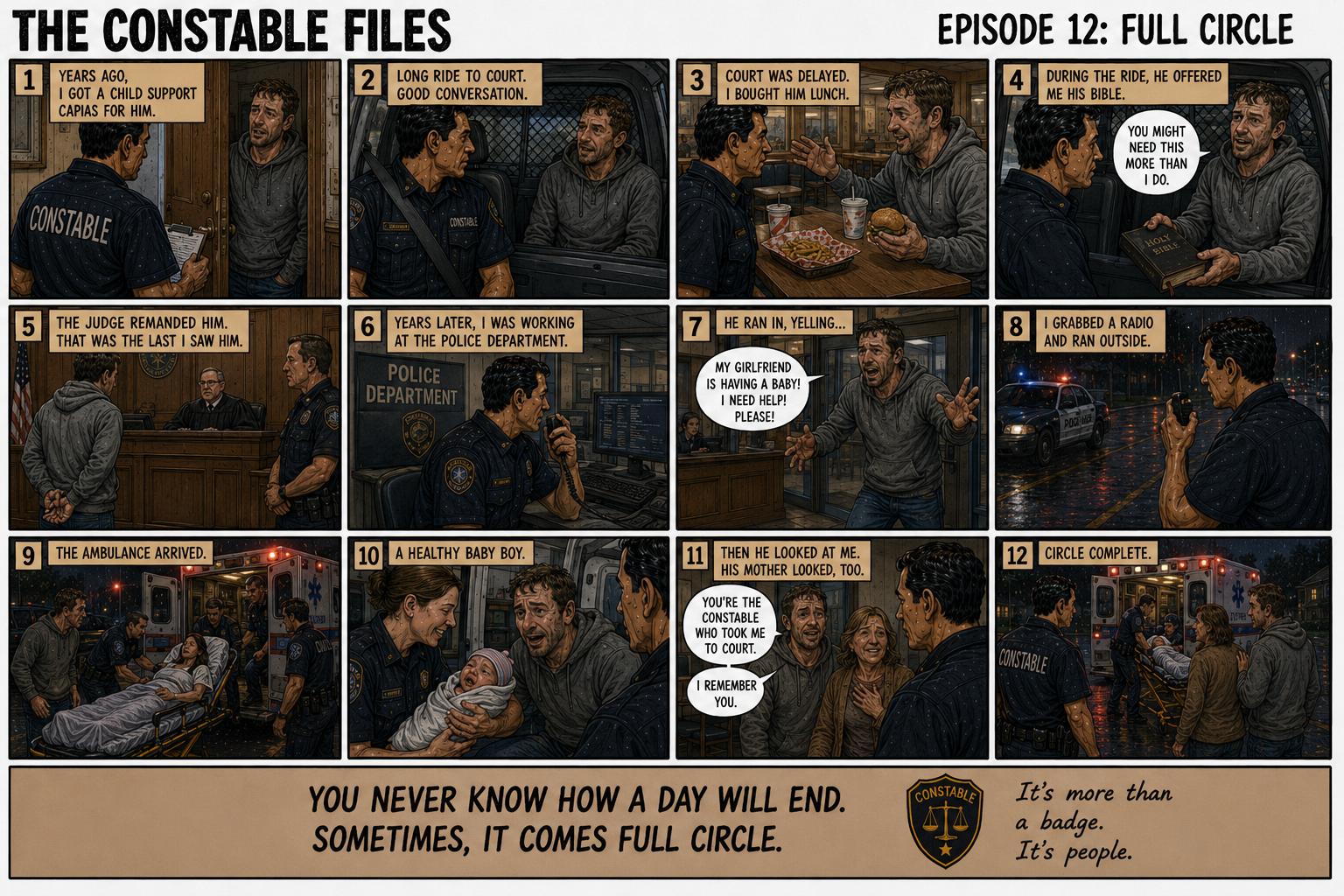
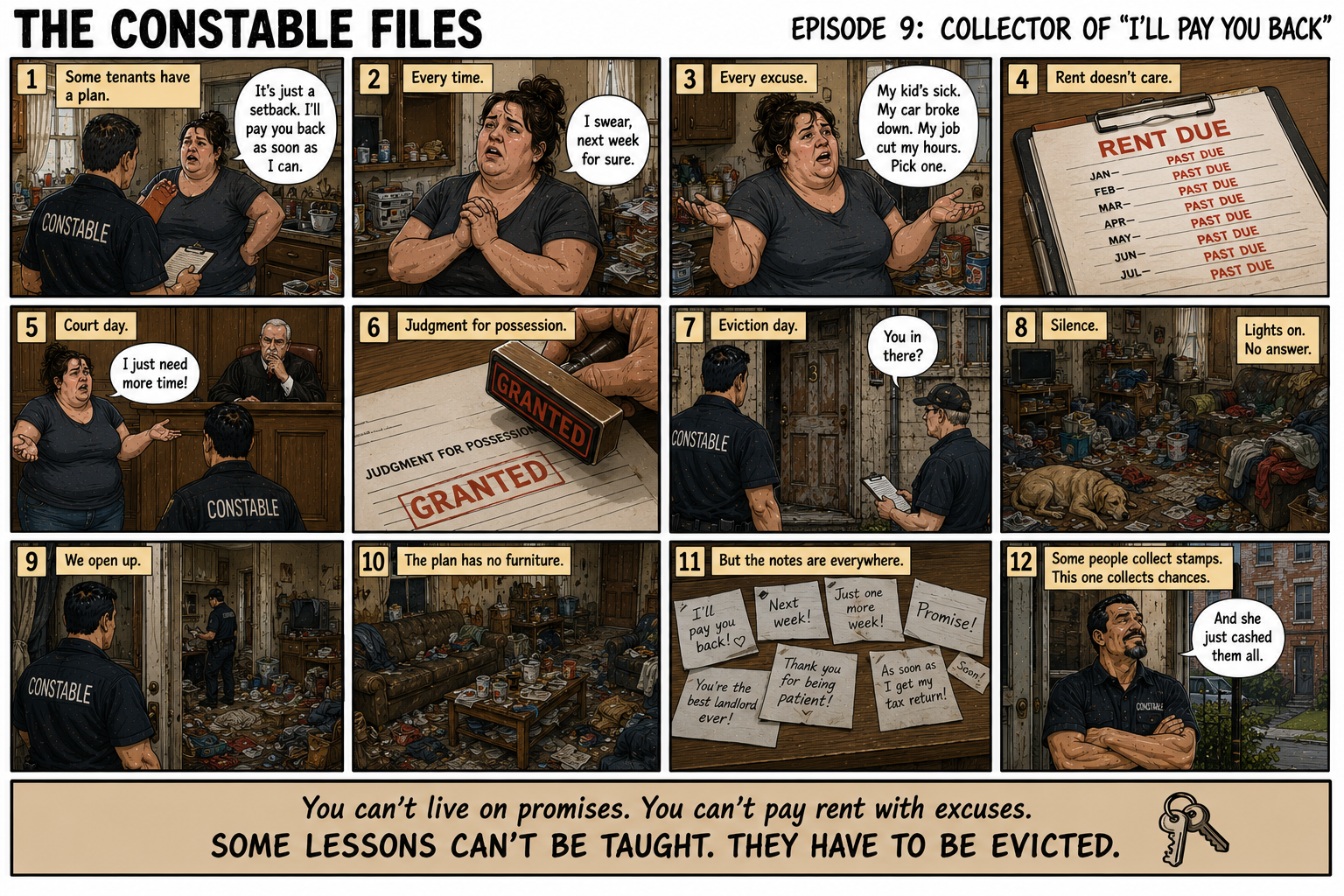
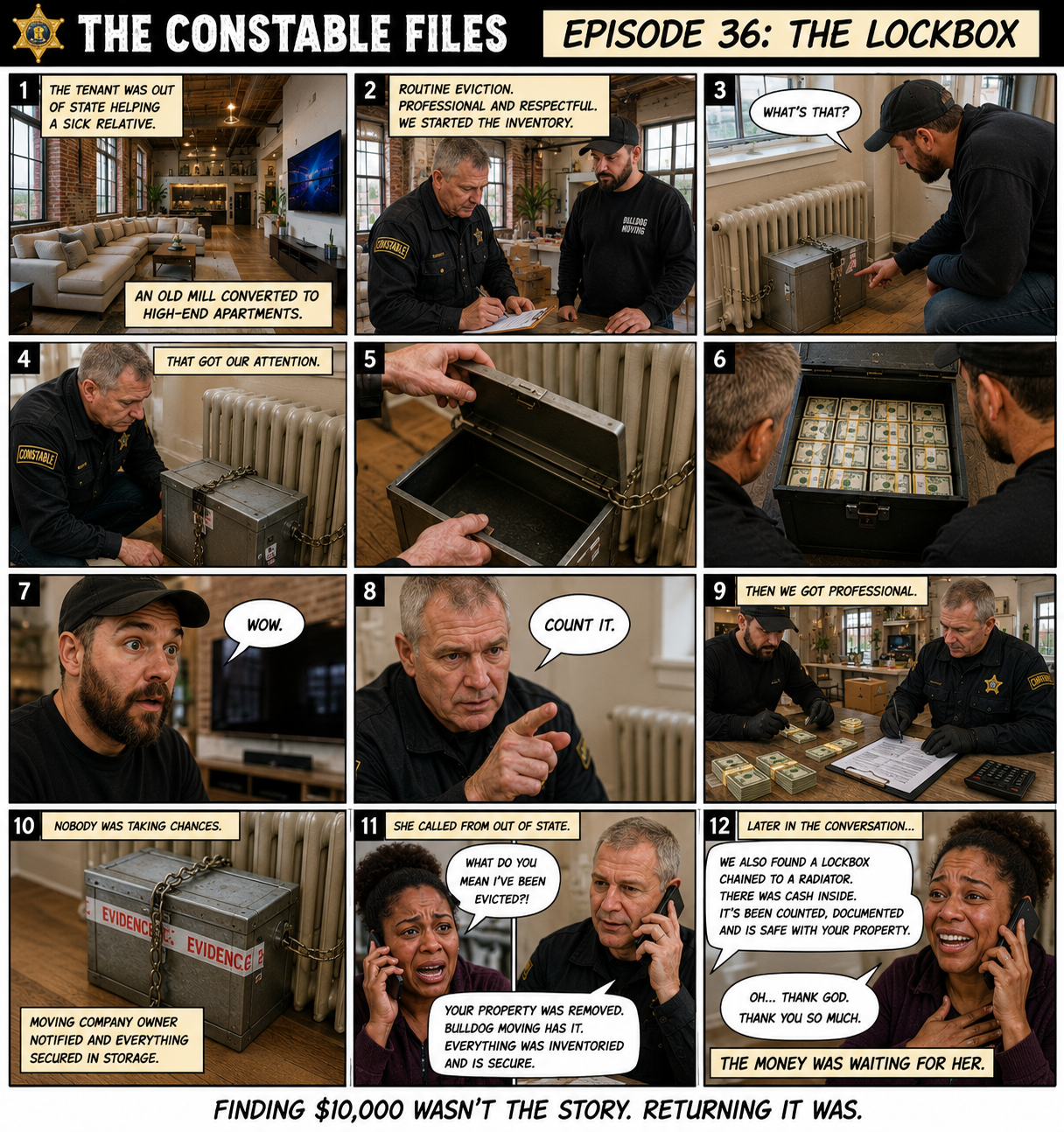
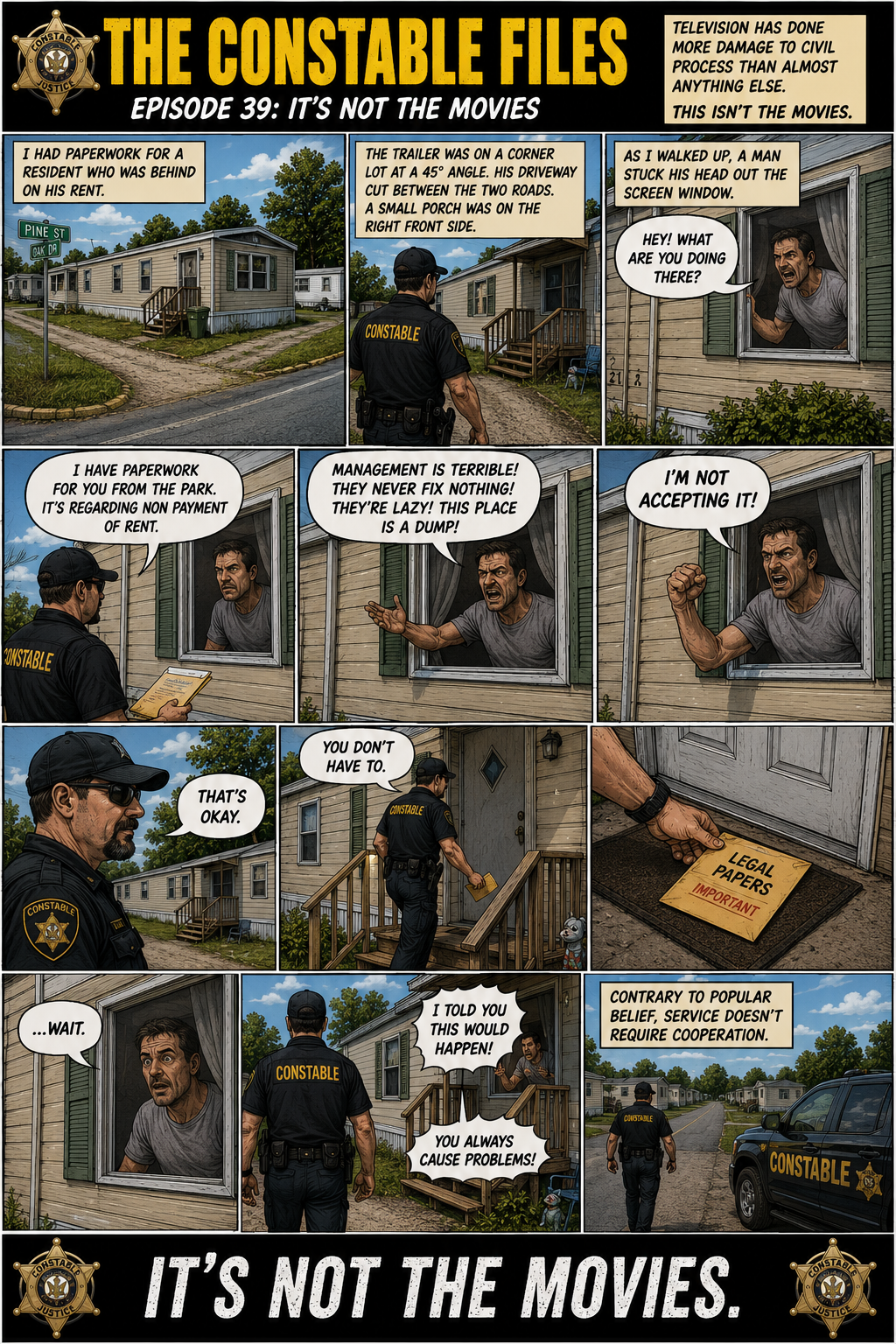
The growing episode archive for The Constable Files.
These category buttons are built from the categories entered on published comics.
4 case files
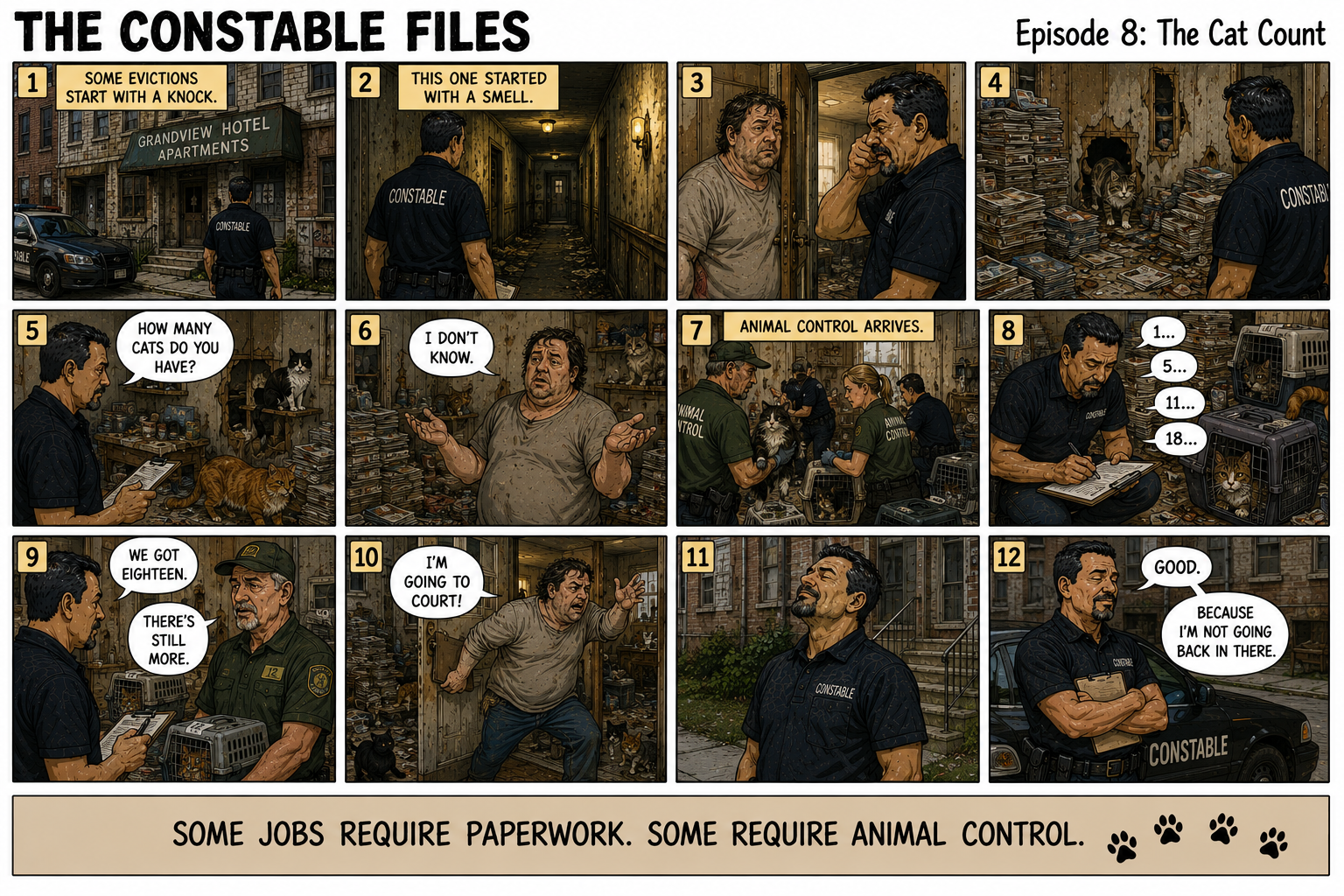
How many cats can live in a single apartment? Alan thought he knew the answer—until an eviction turned into an impossible counting exercise. Every room revealed another feline, and nobody could agree on the final number.
Open this case file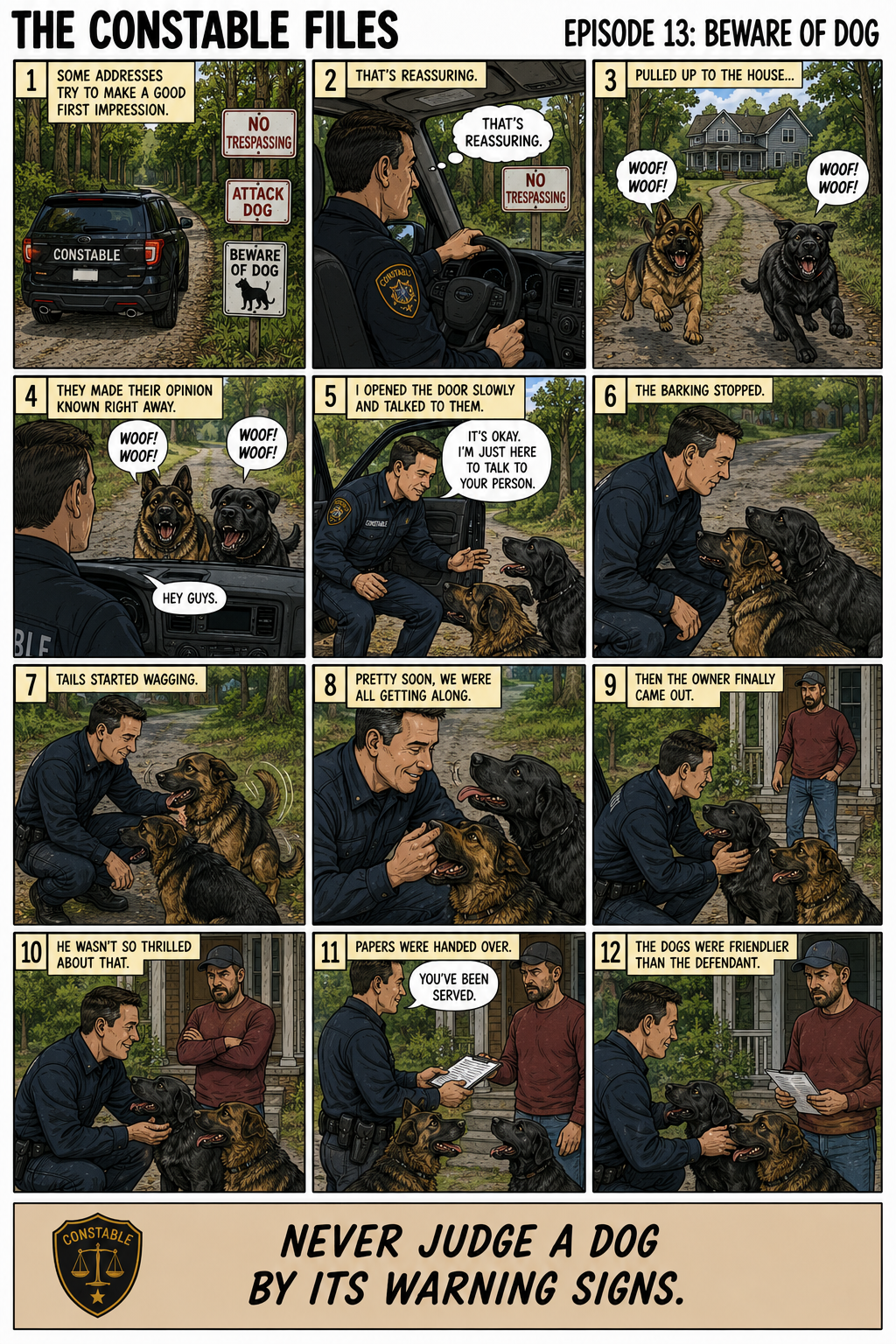
Every process server has seen a "Beware of Dog" sign. Most are warnings. Some are exaggerations. One turned out to be completely accurate. What waited beyond this gate made Alan reconsider every dog sign he had ever ignored.
Open this case file
What started as a training-day eviction quickly became one of the strangest jobs Alan had ever handled. Just when everyone thought it was over, the tenants found a way to turn one eviction into two.
Open this case file
Alan knew something was wrong before he reached the front door. The smell hit from down the street. What waited inside turned out to be one of the worst apartments he had ever encountered.
Open this case file1 case file
1 case file
2 case files
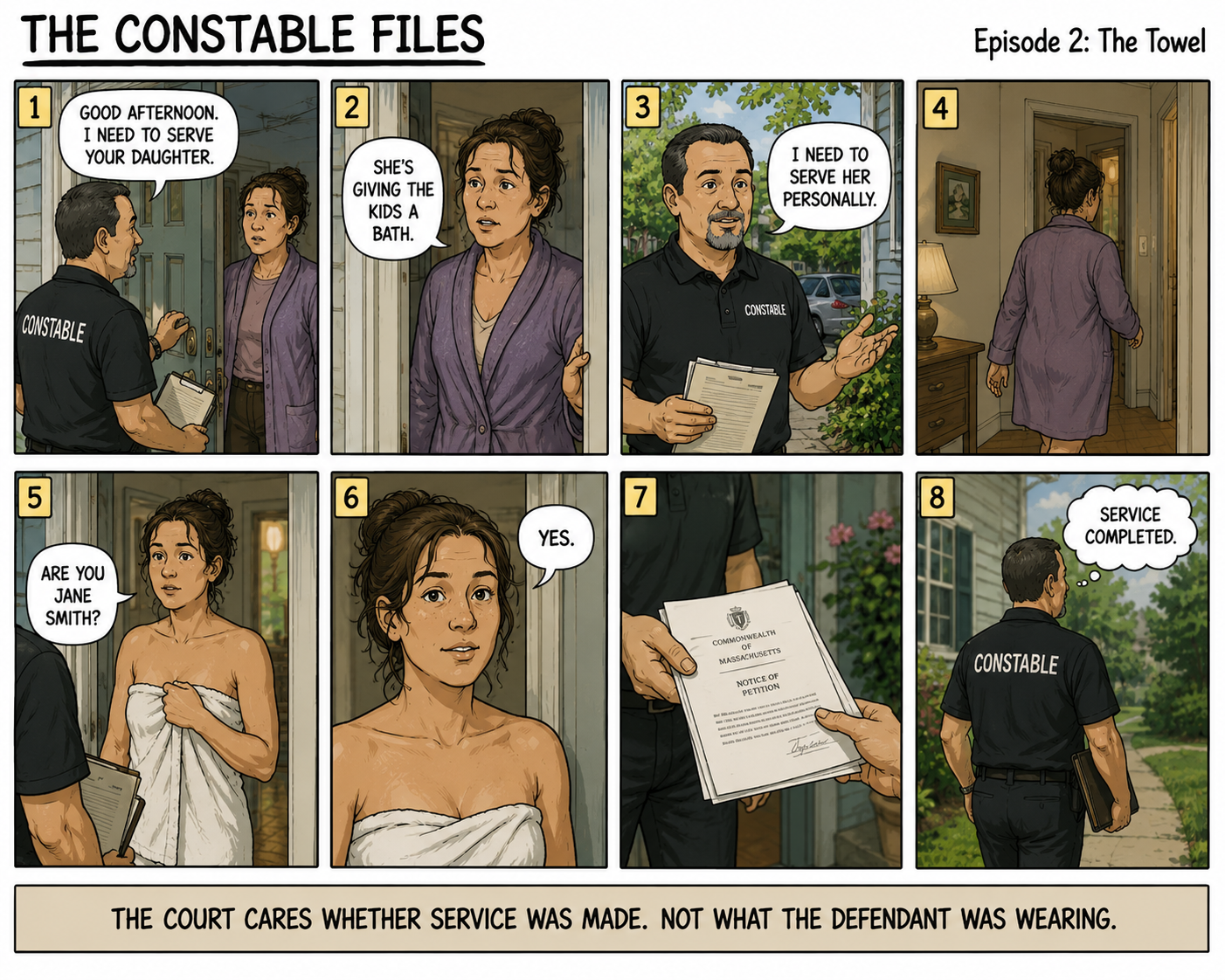
Personal service, awkward timing, and one very memorable doorway.
Open this case file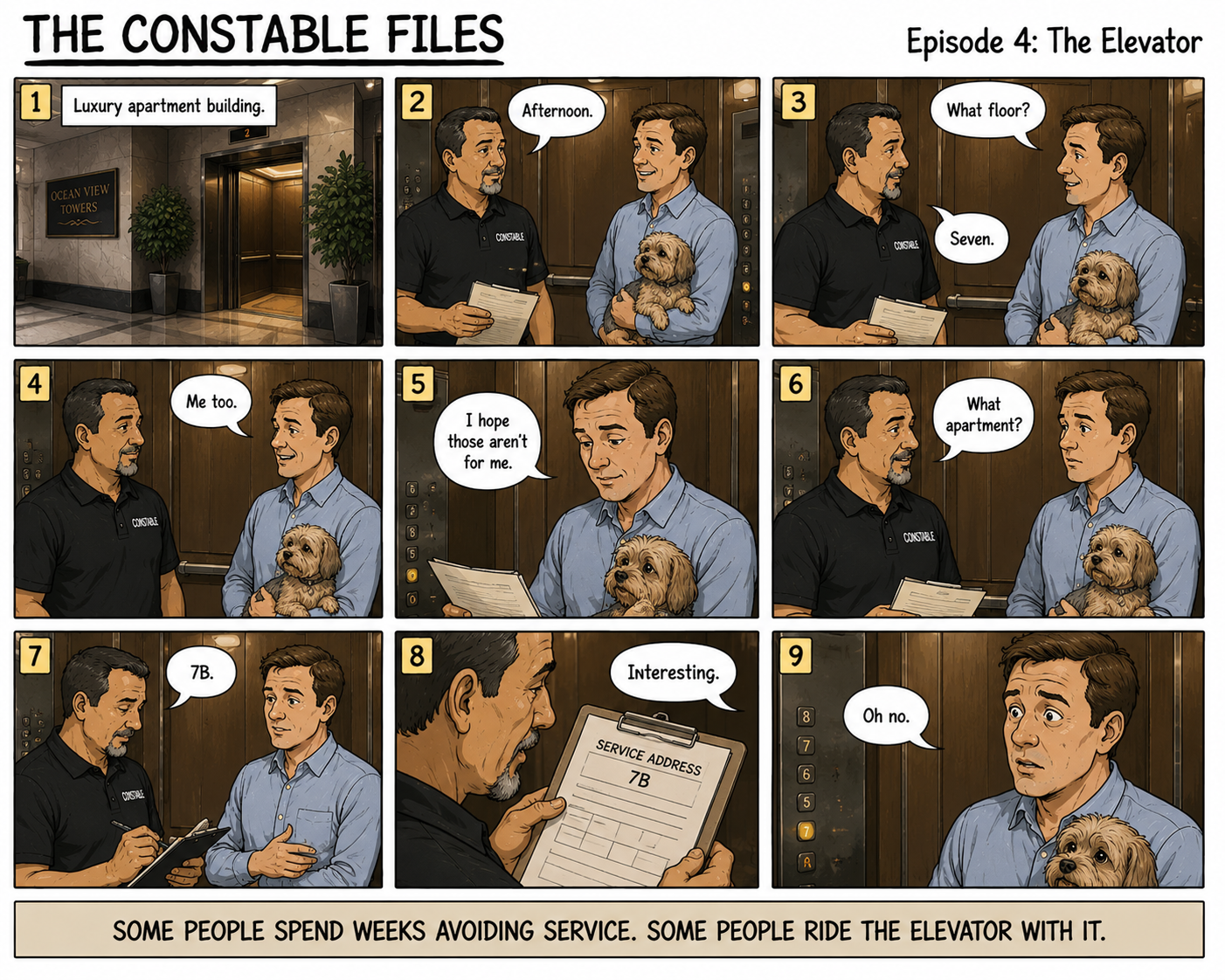
A simple service inside an apartment building should have taken only a few minutes. Then the elevator doors opened. Sometimes the hardest part of the job isn't finding the person—it's surviving the ride.
Open this case file11 case files

BEFORE THE BADGE Volume 1: The Constable The office is older than you think. Long before modern police departments, Massachusetts communities relied on local public officers to carry out responsibilities established by law and local government. Among those offices was the constable. But what was a constable then? Where did his authority come from? And how did an office rooted in seventeenth-century Massachusetts survive into the modern Commonwealth? Volume 1: The Constable begins the story, tracing the office from colonial Massachusetts to today and introducing the changing responsibilities that will be explored throughout Before the Badge. An old office. A changing Commonwealth. A history that continues today.
Open this case file
Volume 2: The Office Takes Root An old English office arrives in a new world. As Massachusetts Bay's early settlements took shape, colonists were building more than homes and towns. They were establishing government, law, and public offices carried from English tradition. Among them was the constable. In Volume 2: The Office Takes Root, discover some of the earliest recorded Massachusetts constables and see how an ancient English office became part of the developing government of Massachusetts. The settlements were new. The office was not.
Open this case file
The law could be written. Someone still had to carry it out. In early Massachusetts, written warrants connected legal authority with action in the community. Constables were among the public officers entrusted with receiving those commands, carrying out the duties assigned to them, and, in some cases, reporting the result. In Volume 3: The Order, follow the written process from the hands of government into the community and discover an early responsibility that would remain closely associated with the constable's office for centuries. Law on the page became action in the community.
Open this case file
When the alarm was raised, the whole community could be called to action. Before professional police forces, pursuing a suspected offender wasn't necessarily the work of a single officer. In early Massachusetts, the hue and cry could summon constables and ordinary residents to search for and apprehend someone who had fled. In Volume 4: The Hue and Cry, discover a system of public order built around alarm, pursuit, and community participation, and a constable's historical authority very different from the office we know today. When someone fled, keeping the peace could become everyone's business.
Open this case file
When darkness fell, the community still needed watching. Before professional police forces, nighttime safety depended on systems very different from those we know today. Colonial communities organized watches to make rounds, look for fire and other dangers, observe disturbances, and summon help when needed. In Volume 5: The Watch, discover how ordinary inhabitants shared responsibility for nighttime vigilance and where the constable fit within this early system of public safety. Before professional policing, keeping watch was a community responsibility.
Open this case file
The constable wasn't the only officer carrying the law beyond the courtroom. As Massachusetts government developed, authority operated at different levels. Constables served within local communities, while another ancient English office, the sheriff, operated across the county. In Volume 6: The Sheriff's County, discover how these two distinct offices became part of the same developing legal system, where their responsibilities could intersect, and why the sheriff was never simply another name for the constable. One served the community. The other served the county.
Open this case file
Before an order could be carried into the community, someone had to exercise the legal authority behind it. From the magistrates of early Massachusetts Bay to the justices of the peace of the provincial era, local lay officials played an important role in administering justice. They heard complaints, made legal determinations, and exercised powers assigned to them by law. In Volume 7: Justice of the Peace, discover how this local judicial office developed, how it differed from the modern judge, and how its work could intersect with that of the constable. A decision could begin inside a room. Carrying it into effect often required someone to step outside it.
Open this case file
There was no single courtroom where every Massachusetts case began and ended. Colonial Massachusetts developed a layered system of magistrates and courts, each exercising different kinds of authority. And unlike courts today, their work could extend beyond deciding cases into responsibilities involving government and community administration. In Volume 8: The Colonial Court, explore how this early judicial system worked, how authority moved through its different levels, and why sheriffs and constables were essential when a court's decision required action beyond its doors. The court could decide. Public officers carried those decisions into the community.
Open this case file
What did a Massachusetts constable actually do? The answer might surprise you. Long before specialized government agencies and professional police departments, the colonial constable wore many hats—without wearing a uniform. A single office could carry lawful process, perform duties for the town, collect public rates when assigned by law, and help maintain public order. In Volume 9: A Day in the Life, follow a representative day built from historically documented responsibilities to discover how one local office connected nearly every part of colonial community life. One office. Many responsibilities. A community depending on them all.
Open this case file
Boston was growing, and the old system was changing. In 1838, Boston established a small daytime police force alongside its existing Night Watch. By 1854, a reorganized Boston Police Department marked a major shift toward professional policing. But one much older office remained.
Open this case file
Professional police arrived. The courts changed. Massachusetts changed. The constable remained. The final volume follows an ancient local office into the modern era and explains how it survived not by remaining unchanged, but by adapting to a changing system of law and government.
Open this case file1 case file
2 case files
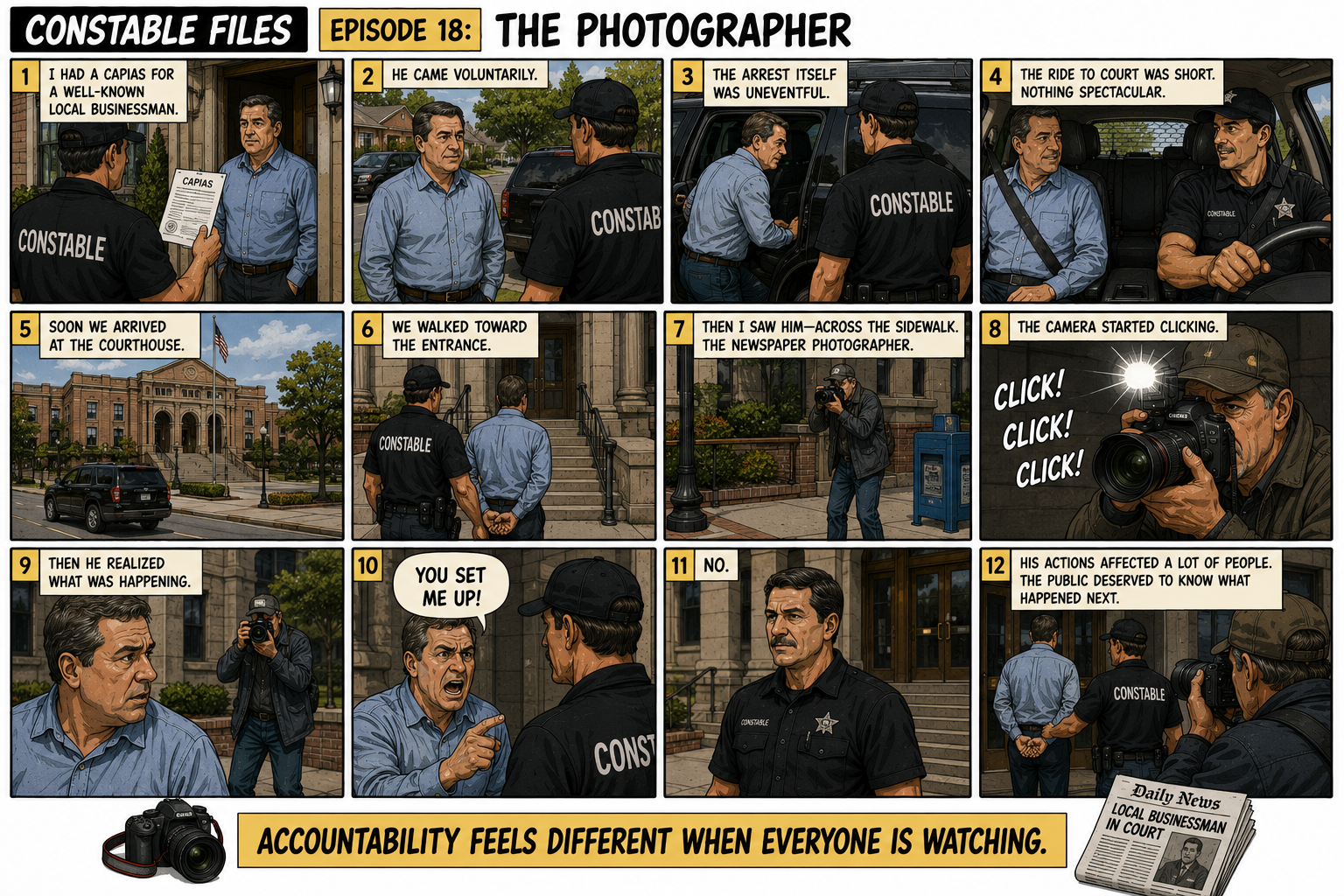
Being brought to court under arrest is stressful enough. Doing it while a newspaper photographer is waiting outside the courthouse is a whole different problem.
Open this case file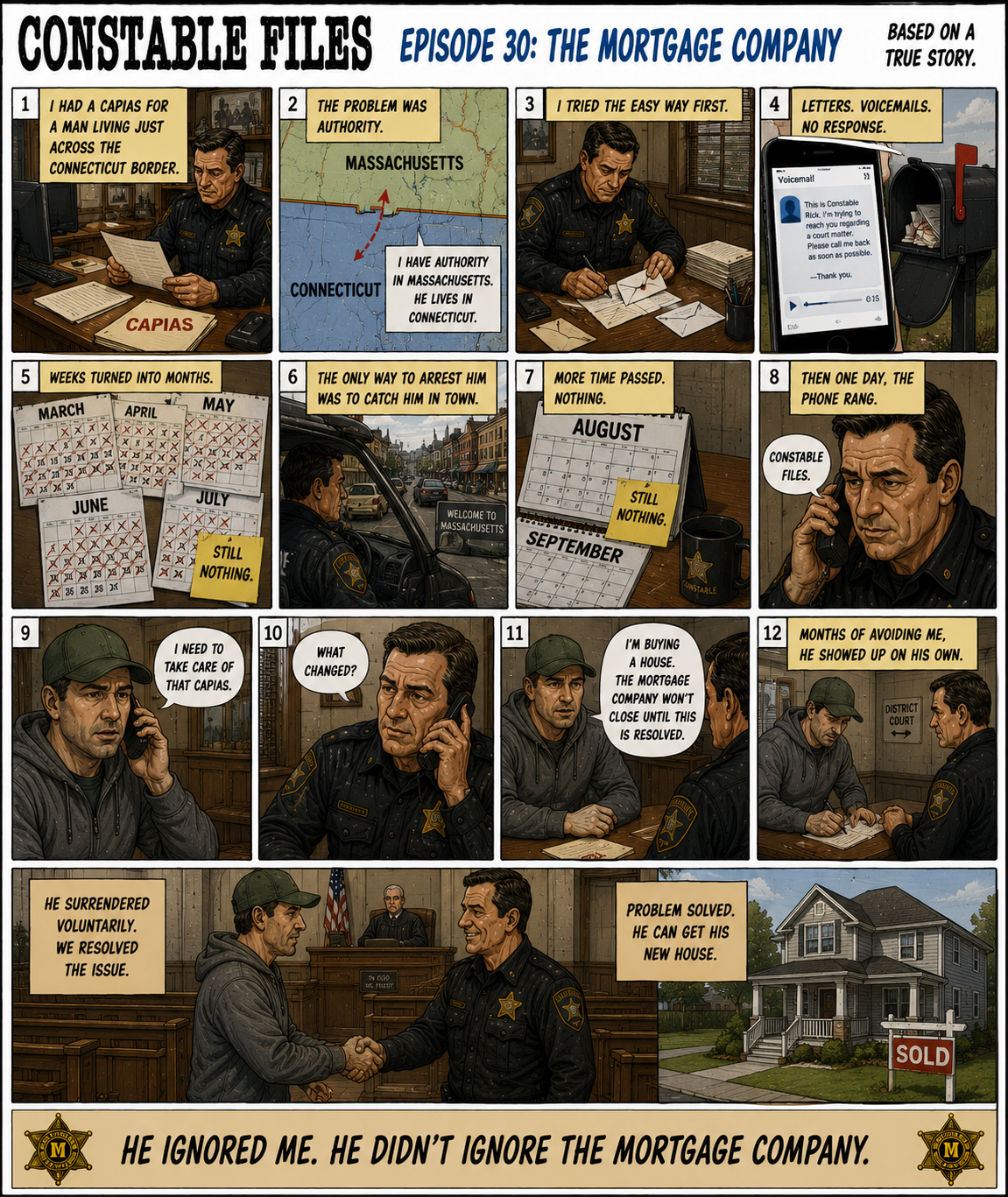
For months, a man ignored letters, phone calls, and every opportunity to resolve a court-issued capias. Then he decided to buy a house. Suddenly, returning Alan's call became a priority.
Open this case file1 case file
1 case file
3 case files

A $70 invoice could have been paid with a single check. Instead, a year of broken promises turned it into a lesson about principles, persistence, and why you should never lie to Lance.
Open this case file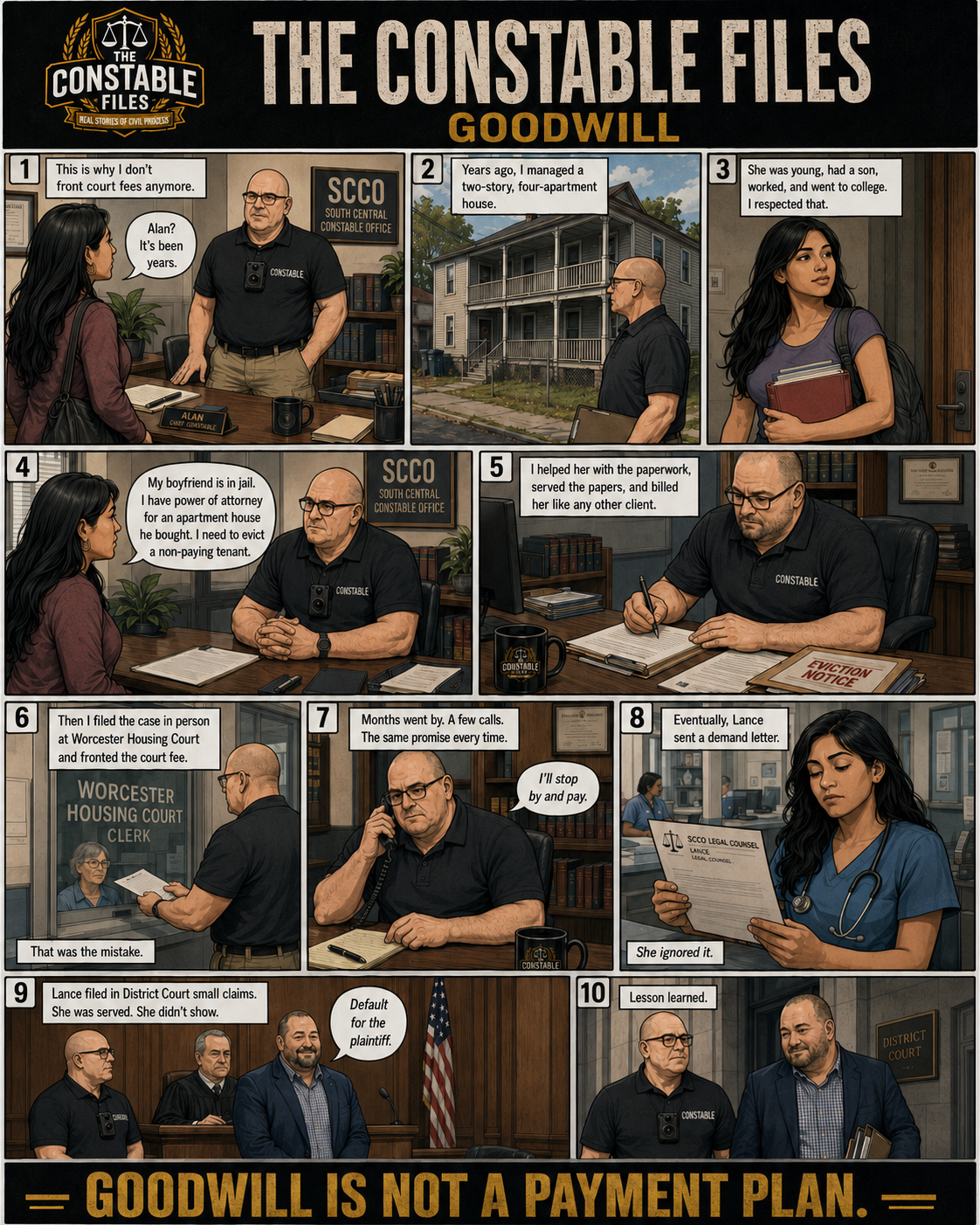
A struggling young landlord needed help. Alan gave her every break he could. Years later, he learned that goodwill is not a substitute for payment.
Open this case file
A major manufacturer had a judgment against them. Two and a half hours in a conference room proved cheaper than ignoring it.
Open this case file1 case file
2 case files

Hours into a commercial eviction, Alan needed a bathroom break. Instead, he stumbled onto the first clue that explained why the business looked more like an apartment than a dealership.
Open this case file
A motorcycle shop owner knew the eviction was coming and even tried to stop it in court. His employees called him while we were there. Police kept driving past. But when the locks were finally changed, there was still one person we hadn't seen: the owner.
Open this case file4 case files
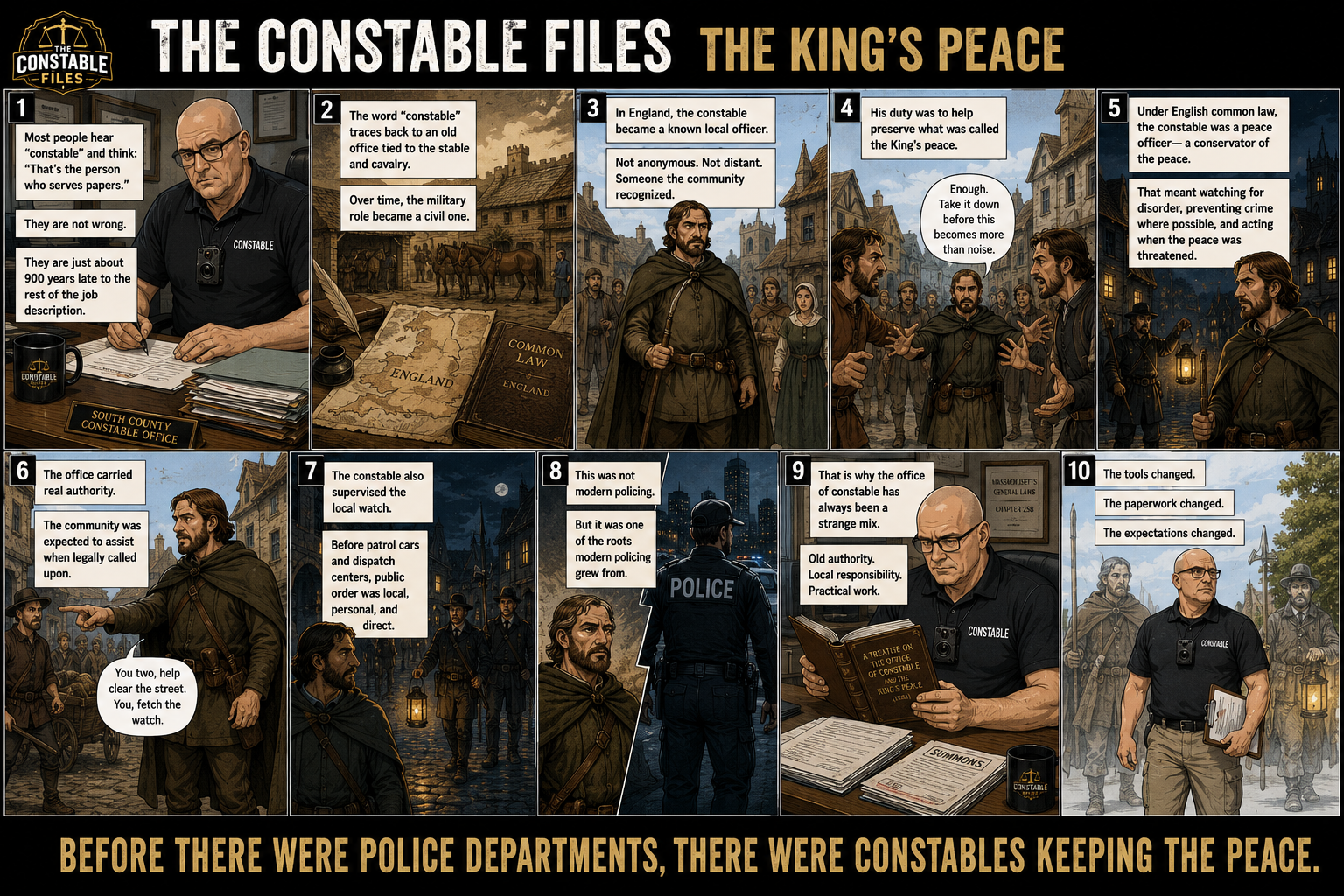
Before police departments, dispatch centers, and patrol cars, there were constables: local officers charged with keeping the King’s peace.
Open this case file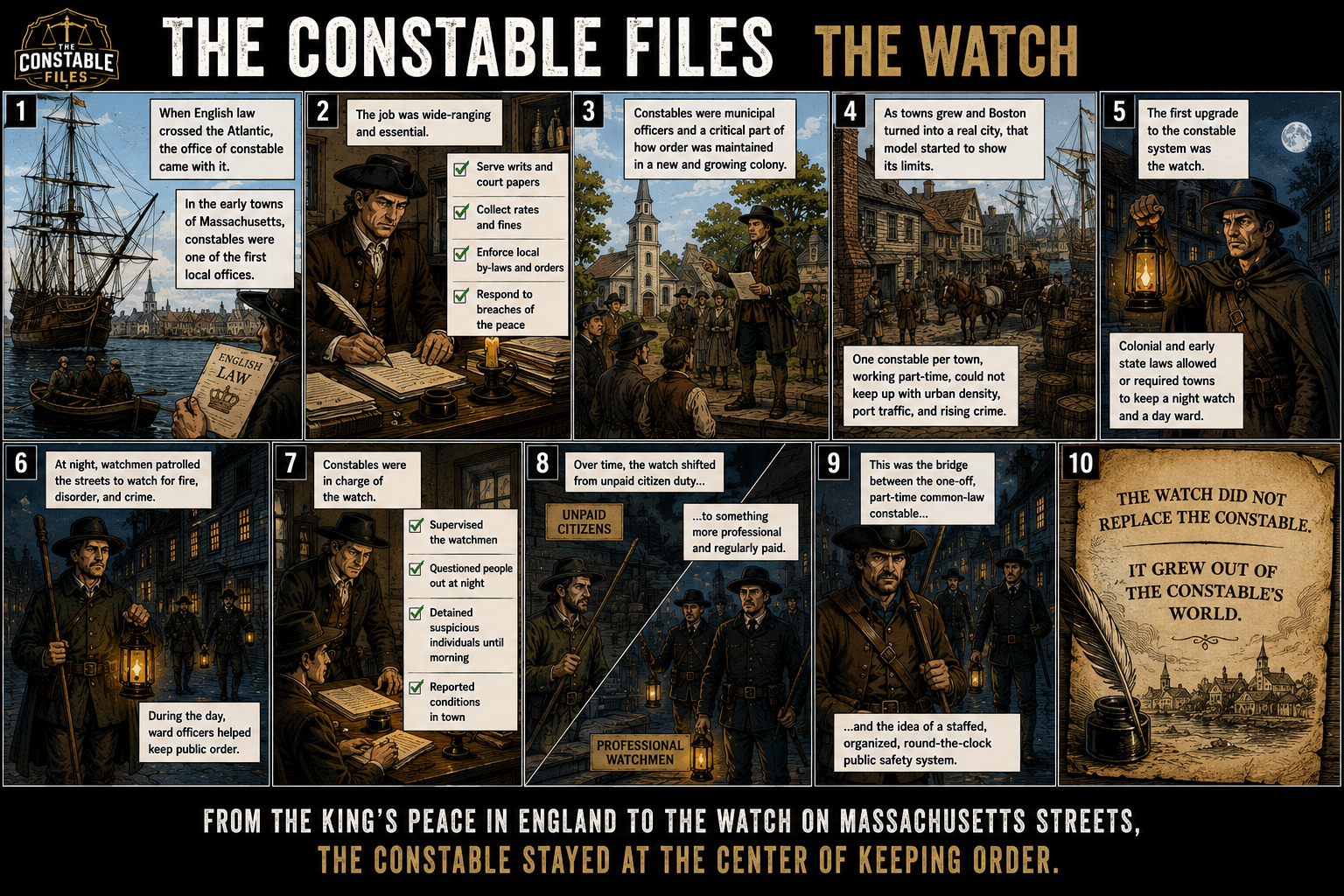
Before modern police departments, Massachusetts towns relied on constables and the watch. Together, they formed the foundation of organized public safety.
Open this case file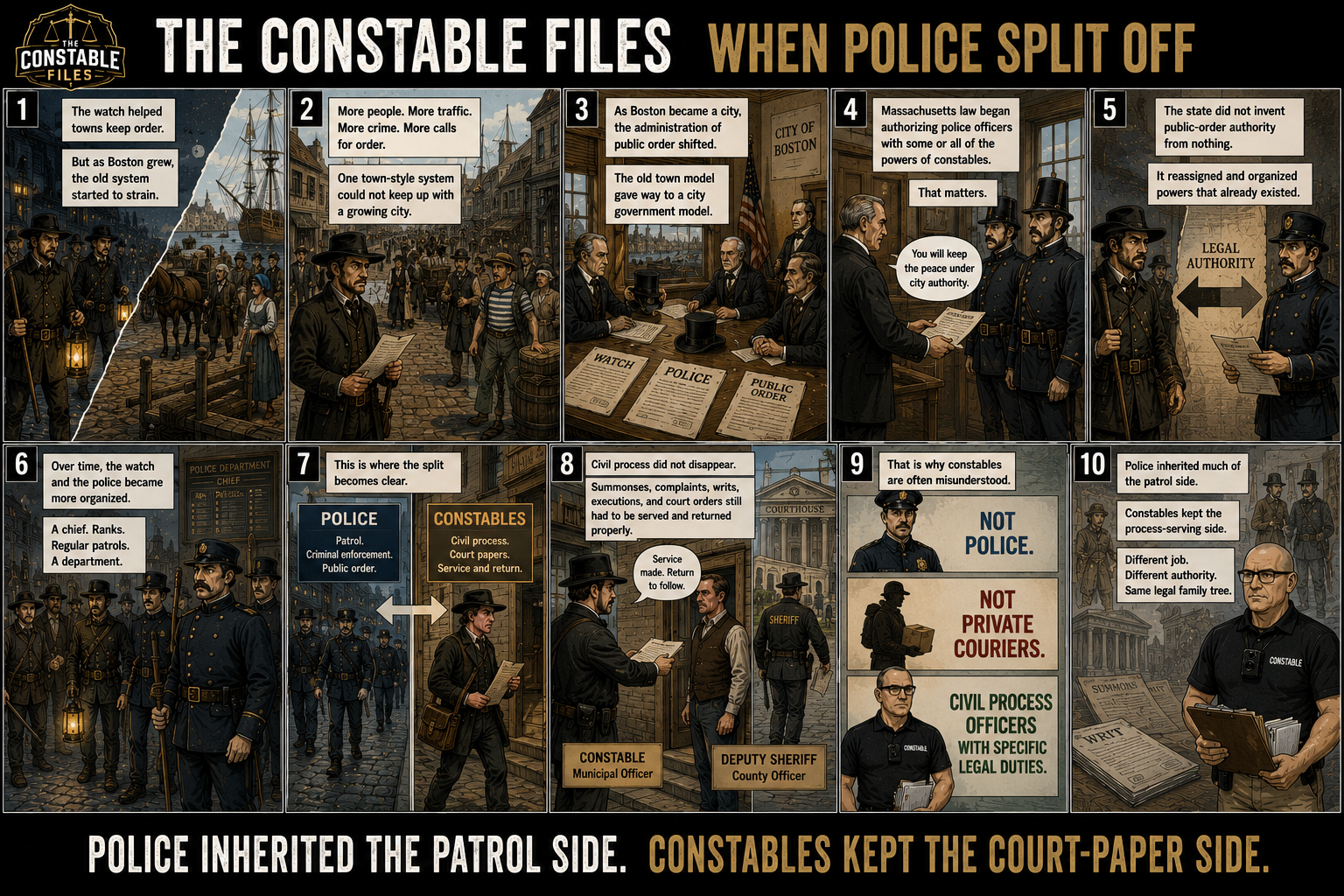
Police and constables share common roots, but they did not evolve into the same job. One inherited patrol duties. The other remained connected to the courts.
Open this case file
The office of constable may be centuries old, but modern expectations demand training, documentation, accountability, and professionalism.
Open this case file1 case file
1 case file
1 case file
1 case file
1 case file
1 case file
5 case files
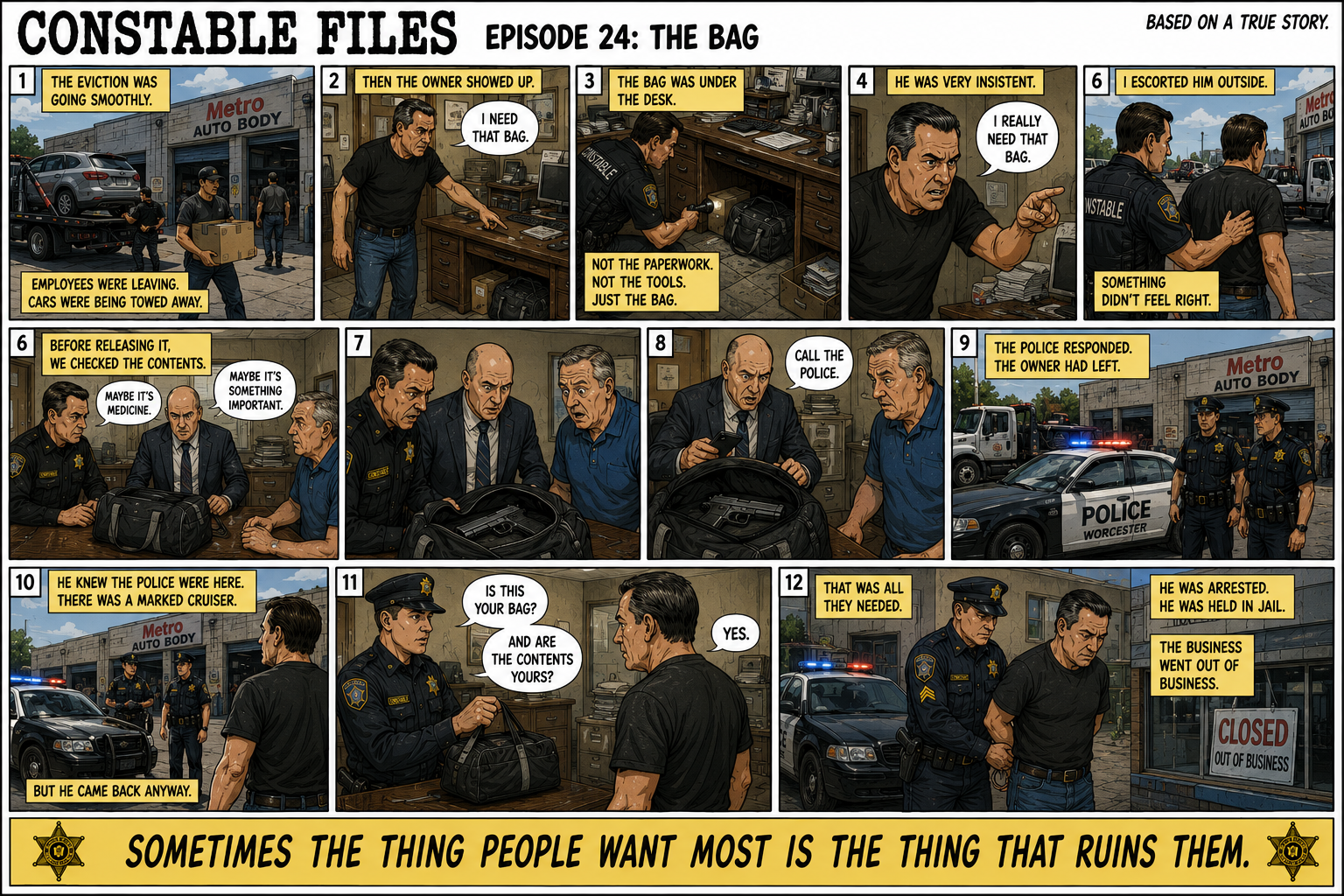
The eviction was routine. The bag was not. When a business owner became unusually desperate to retrieve one specific item, Alan began to suspect there was a reason—and he was right.
Open this case file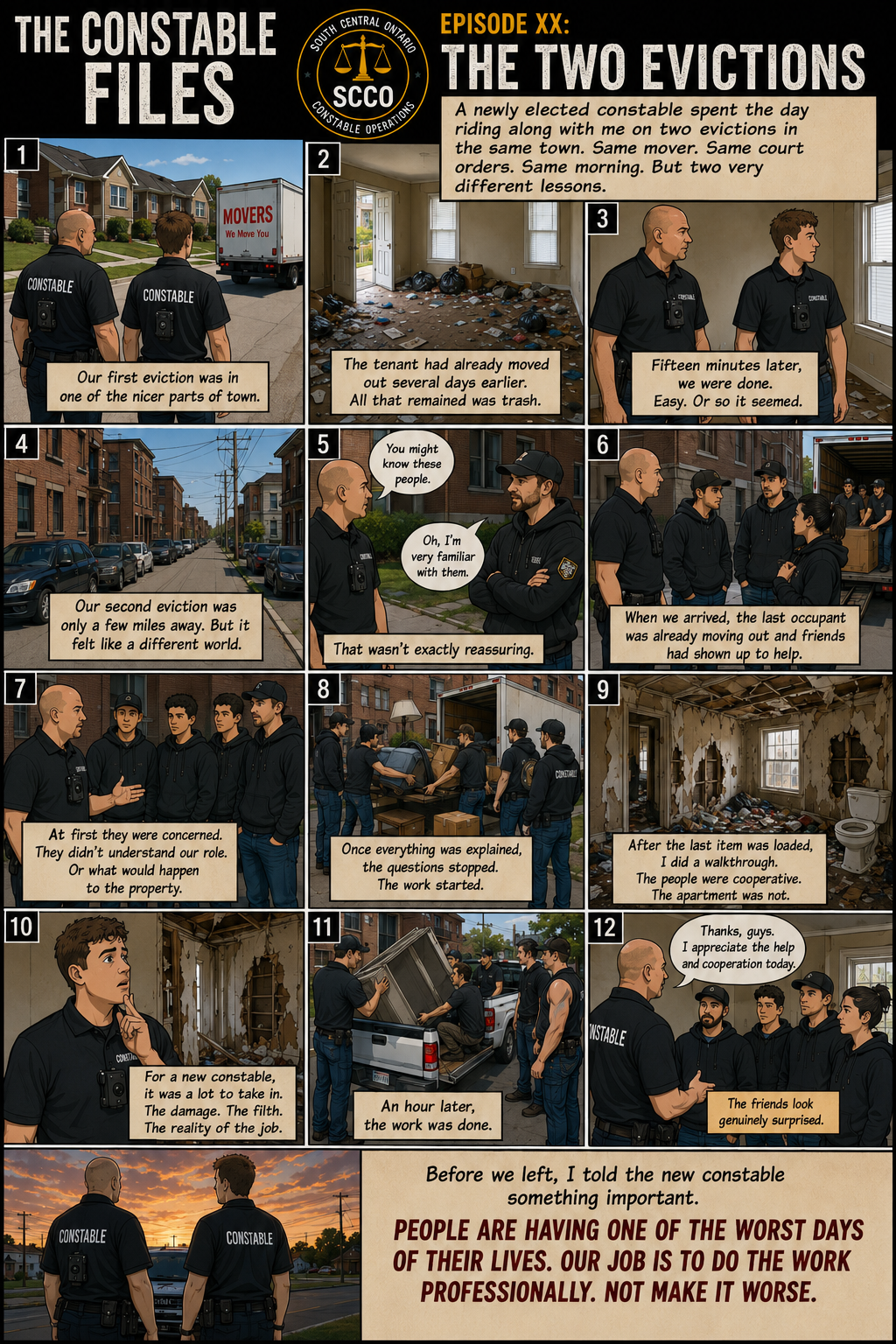
A newly elected constable rode along for two evictions on the same day. One was easy. The other revealed the reality of the job—and an important lesson about how people should be treated.
Open this case file
Some scenes can’t be captured in a photograph. After documenting a recently vacated apartment, the movers’ supervisor looked at me and said: “Good thing you can’t photograph smell.” Some jobs stay with you for reasons you never expect.
Open this case file
After more than 25 years, I'd finally found the cleanest eviction I'd ever seen. Then the neighbor walked over and said four words: “That's my stuff.”
Open this case file
The eviction was over. The property was emptied. Possession had been returned. Then a working key changed everything. A true story about why changing the locks immediately after an eviction isn't just a recommendation—it may prevent an entirely new incident.
Open this case file1 case file
3 case files

Most foreclosure executions involve strangers. This one involved a family Alan had known since childhood. What should have been another address on a file became a reminder that some cases stay with you long after the paperwork is finished.
Open this case file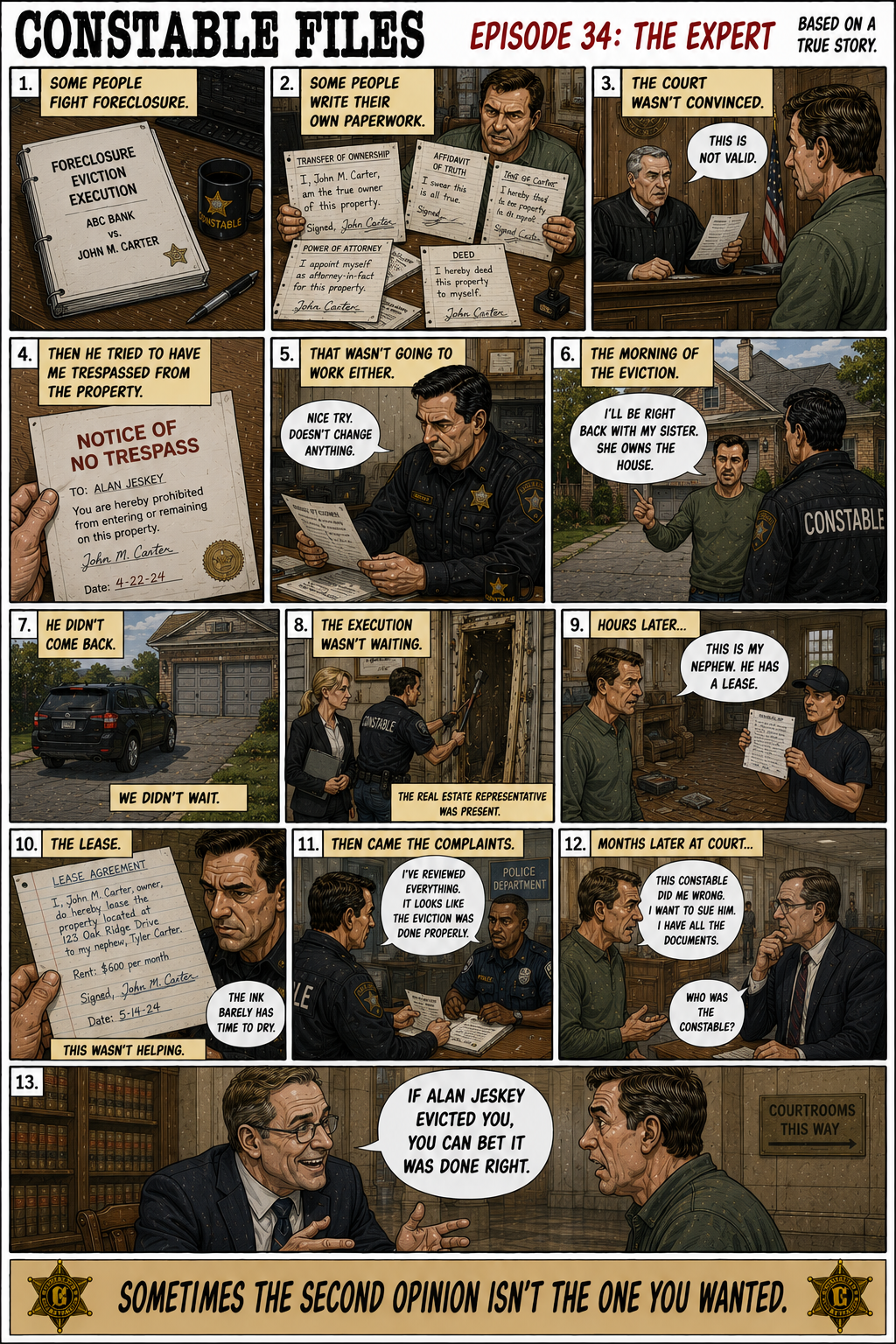
Some people challenge a foreclosure in court. Others try something more creative. This homeowner had a stack of homemade legal documents and complete confidence that he understood the law better than everyone else.
Open this case file
From the street, it looked like an ordinary home in a quiet neighborhood. What waited behind the front door told a very different story—one that had taken years to unfold.
Open this case file1 case file
2 case files
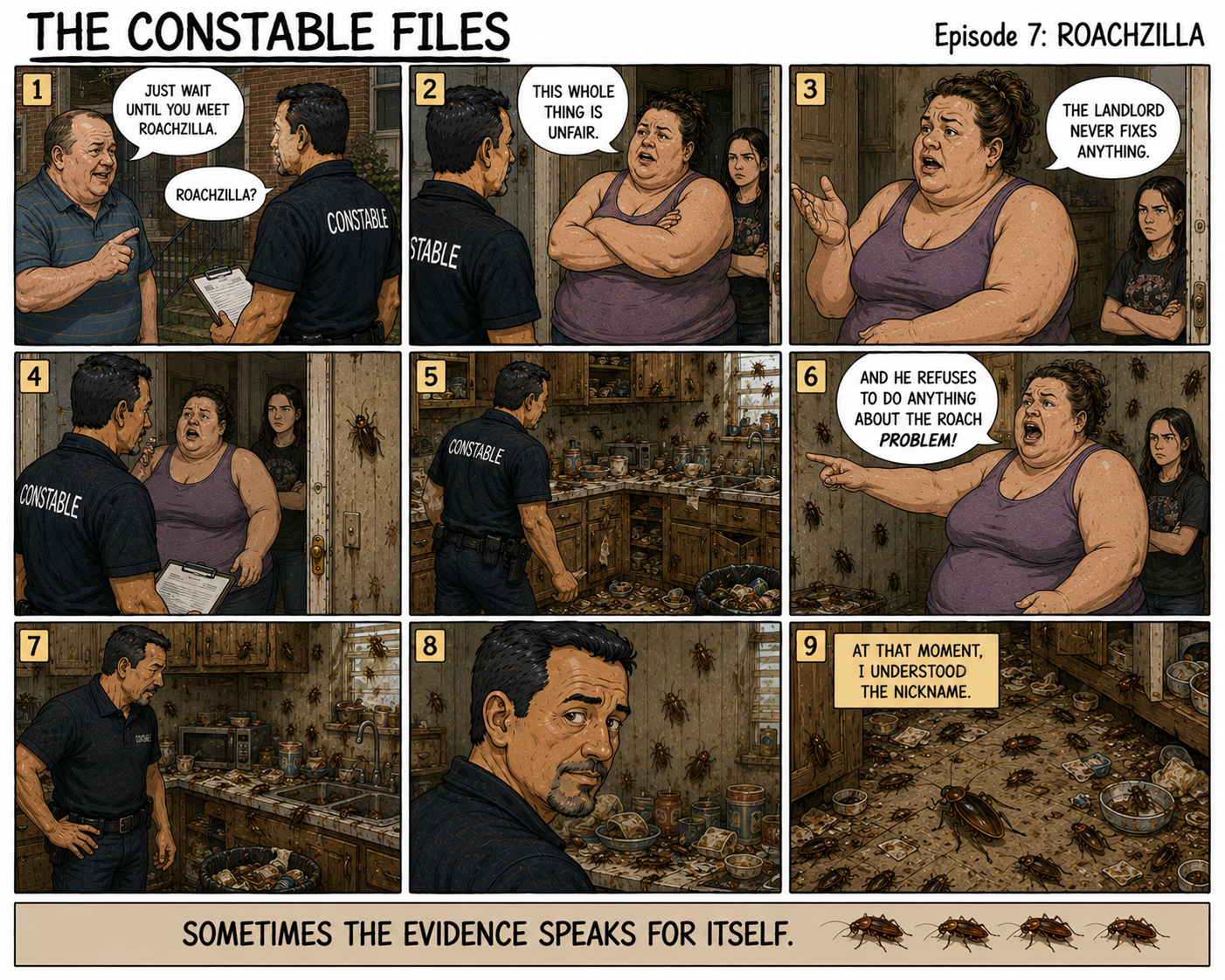
Every constable has stories that make people lose their appetite. This is one of them. What began as a routine eviction quickly became a battle against an army of unwanted occupants—and one roach large enough to earn a name of its own.
Open this case file Alan knew something was wrong before he reached the front door. The smell hit from down the street. What waited inside turned out to be one of the worst apartments he had ever encountered.
Open this case file12 case files

Before the stories begin, Alan answers the question everyone asks first: what exactly is a constable?
Open this case file BEFORE THE BADGE Volume 1: The Constable The office is older than you think. Long before modern police departments, Massachusetts communities relied on local public officers to carry out responsibilities established by law and local government. Among those offices was the constable. But what was a constable then? Where did his authority come from? And how did an office rooted in seventeenth-century Massachusetts survive into the modern Commonwealth? Volume 1: The Constable begins the story, tracing the office from colonial Massachusetts to today and introducing the changing responsibilities that will be explored throughout Before the Badge. An old office. A changing Commonwealth. A history that continues today.
Open this case file Volume 2: The Office Takes Root An old English office arrives in a new world. As Massachusetts Bay's early settlements took shape, colonists were building more than homes and towns. They were establishing government, law, and public offices carried from English tradition. Among them was the constable. In Volume 2: The Office Takes Root, discover some of the earliest recorded Massachusetts constables and see how an ancient English office became part of the developing government of Massachusetts. The settlements were new. The office was not.
Open this case file The law could be written. Someone still had to carry it out. In early Massachusetts, written warrants connected legal authority with action in the community. Constables were among the public officers entrusted with receiving those commands, carrying out the duties assigned to them, and, in some cases, reporting the result. In Volume 3: The Order, follow the written process from the hands of government into the community and discover an early responsibility that would remain closely associated with the constable's office for centuries. Law on the page became action in the community.
Open this case file When the alarm was raised, the whole community could be called to action. Before professional police forces, pursuing a suspected offender wasn't necessarily the work of a single officer. In early Massachusetts, the hue and cry could summon constables and ordinary residents to search for and apprehend someone who had fled. In Volume 4: The Hue and Cry, discover a system of public order built around alarm, pursuit, and community participation, and a constable's historical authority very different from the office we know today. When someone fled, keeping the peace could become everyone's business.
Open this case file When darkness fell, the community still needed watching. Before professional police forces, nighttime safety depended on systems very different from those we know today. Colonial communities organized watches to make rounds, look for fire and other dangers, observe disturbances, and summon help when needed. In Volume 5: The Watch, discover how ordinary inhabitants shared responsibility for nighttime vigilance and where the constable fit within this early system of public safety. Before professional policing, keeping watch was a community responsibility.
Open this case file The constable wasn't the only officer carrying the law beyond the courtroom. As Massachusetts government developed, authority operated at different levels. Constables served within local communities, while another ancient English office, the sheriff, operated across the county. In Volume 6: The Sheriff's County, discover how these two distinct offices became part of the same developing legal system, where their responsibilities could intersect, and why the sheriff was never simply another name for the constable. One served the community. The other served the county.
Open this case file Before an order could be carried into the community, someone had to exercise the legal authority behind it. From the magistrates of early Massachusetts Bay to the justices of the peace of the provincial era, local lay officials played an important role in administering justice. They heard complaints, made legal determinations, and exercised powers assigned to them by law. In Volume 7: Justice of the Peace, discover how this local judicial office developed, how it differed from the modern judge, and how its work could intersect with that of the constable. A decision could begin inside a room. Carrying it into effect often required someone to step outside it.
Open this case file There was no single courtroom where every Massachusetts case began and ended. Colonial Massachusetts developed a layered system of magistrates and courts, each exercising different kinds of authority. And unlike courts today, their work could extend beyond deciding cases into responsibilities involving government and community administration. In Volume 8: The Colonial Court, explore how this early judicial system worked, how authority moved through its different levels, and why sheriffs and constables were essential when a court's decision required action beyond its doors. The court could decide. Public officers carried those decisions into the community.
Open this case file What did a Massachusetts constable actually do? The answer might surprise you. Long before specialized government agencies and professional police departments, the colonial constable wore many hats—without wearing a uniform. A single office could carry lawful process, perform duties for the town, collect public rates when assigned by law, and help maintain public order. In Volume 9: A Day in the Life, follow a representative day built from historically documented responsibilities to discover how one local office connected nearly every part of colonial community life. One office. Many responsibilities. A community depending on them all.
Open this case file Boston was growing, and the old system was changing. In 1838, Boston established a small daytime police force alongside its existing Night Watch. By 1854, a reorganized Boston Police Department marked a major shift toward professional policing. But one much older office remained.
Open this case file Professional police arrived. The courts changed. Massachusetts changed. The constable remained. The final volume follows an ancient local office into the modern era and explains how it survived not by remaining unchanged, but by adapting to a changing system of law and government.
Open this case file1 case file
12 case files
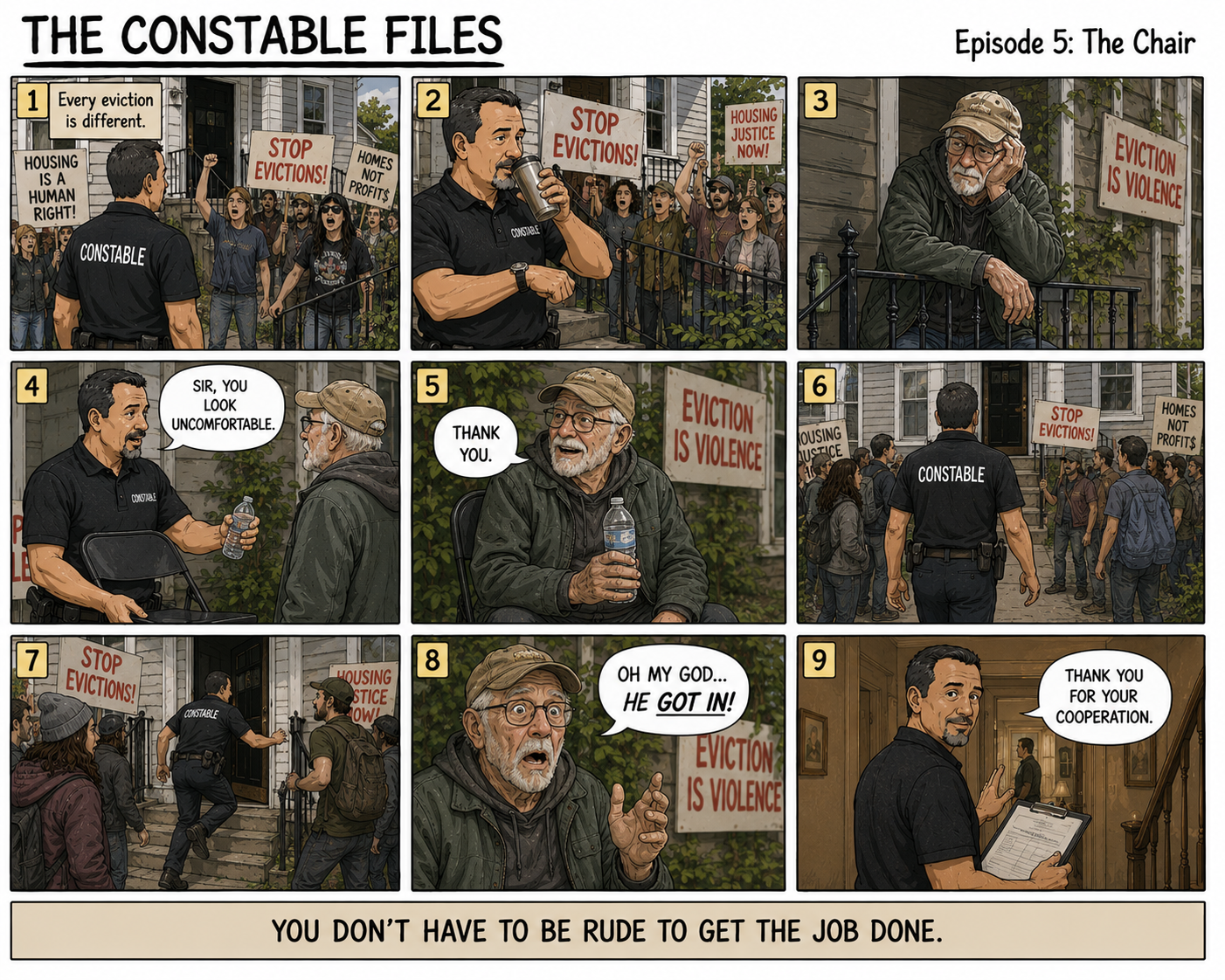
Most people answer the door. Some hide. One man chose a completely different strategy. A simple service attempt turns into an unforgettable standoff involving a lawn chair, patience, and a constable who wasn't leaving anytime soon.
Open this case file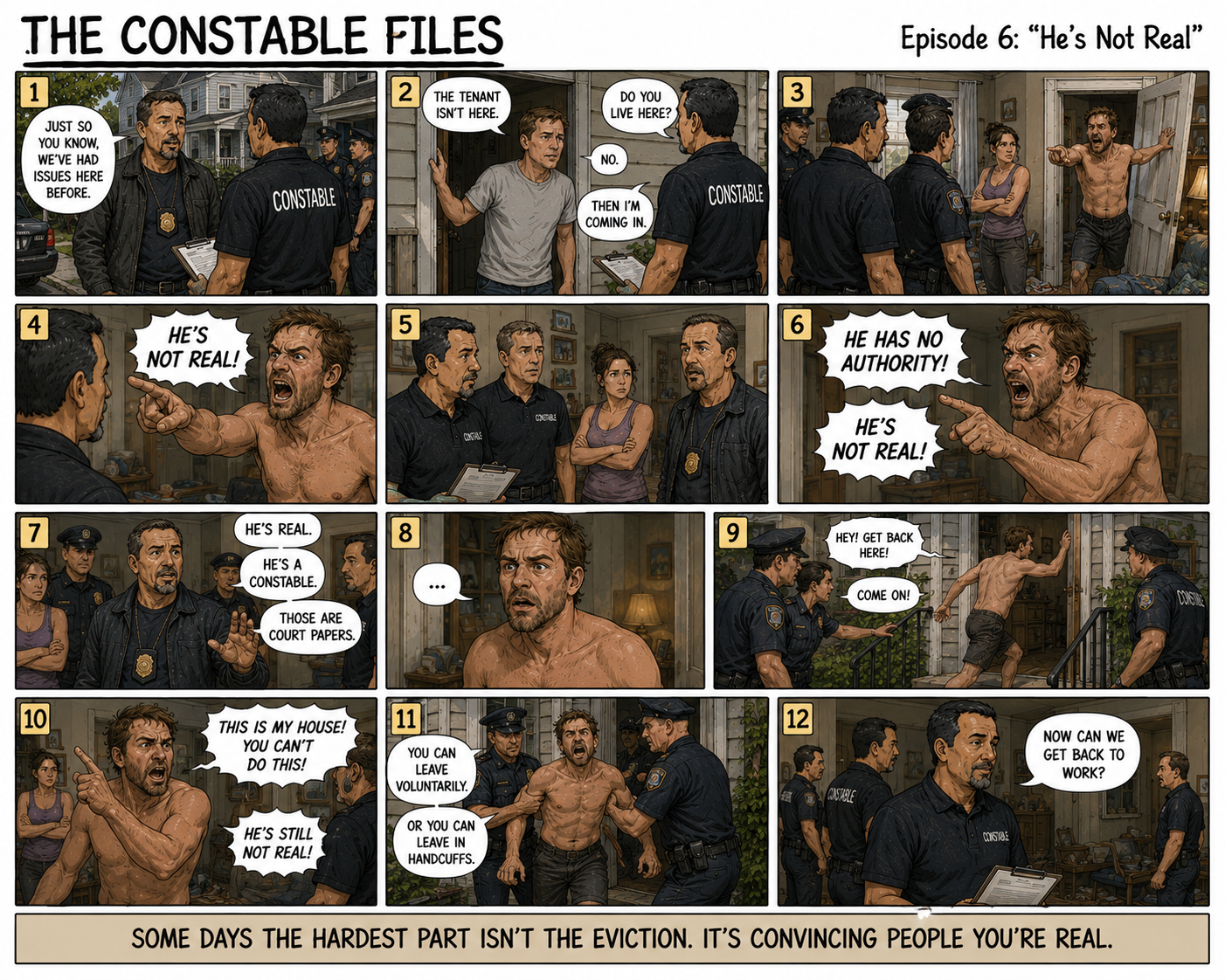
A routine service turns bizarre when a resident insists that the person Alan is looking for doesn't exist. The only problem? The evidence says otherwise. Sometimes the hardest part of serving papers isn't finding people—it's convincing others they're real.
Open this case file Every process server has seen a "Beware of Dog" sign. Most are warnings. Some are exaggerations. One turned out to be completely accurate. What waited beyond this gate made Alan reconsider every dog sign he had ever ignored.
Open this case file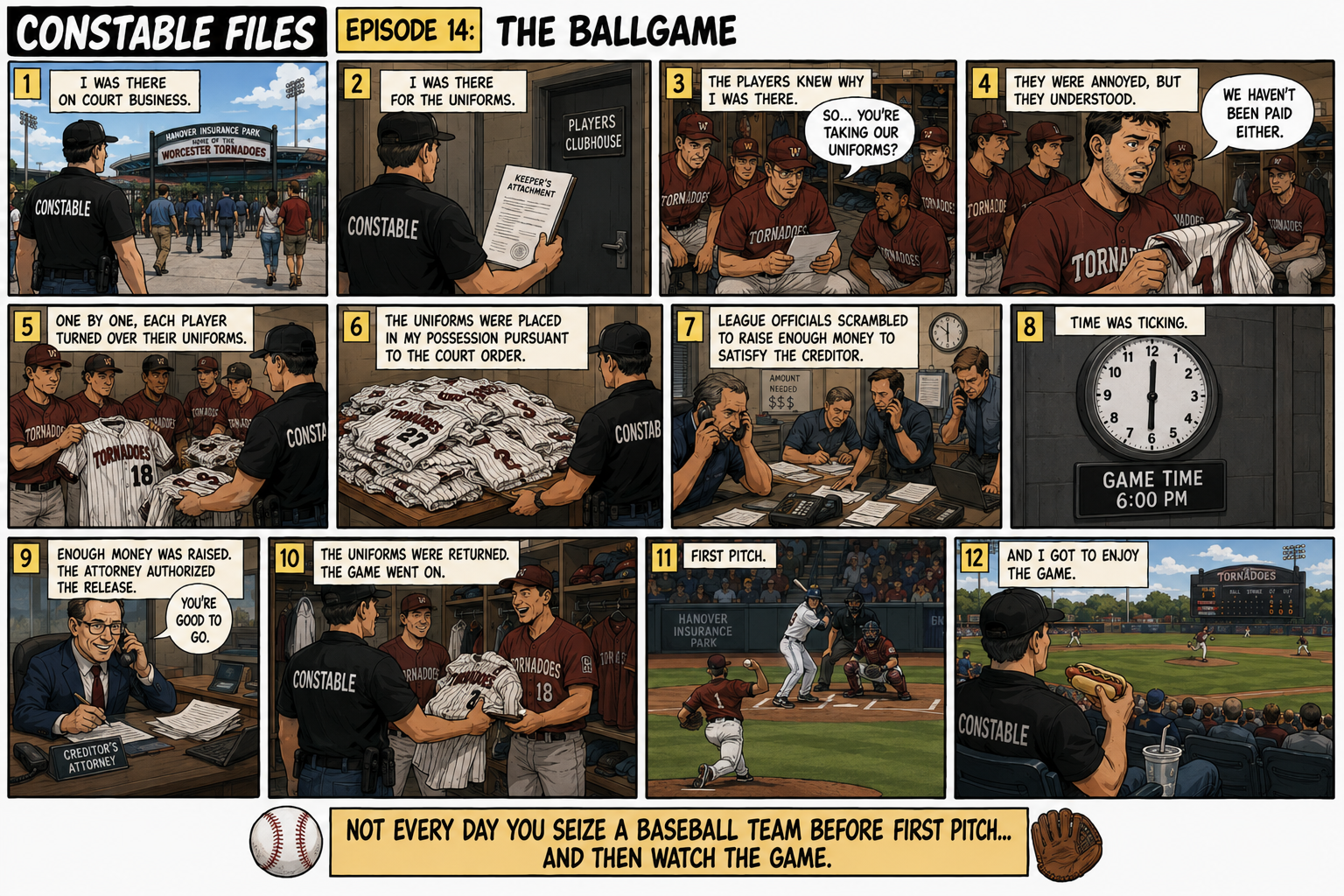
Most people expect to be served at home or work. One recipient got served at a baseball game. What followed was an awkward, public, and unexpectedly funny reminder that legal paperwork can show up almost anywhere.
Open this case file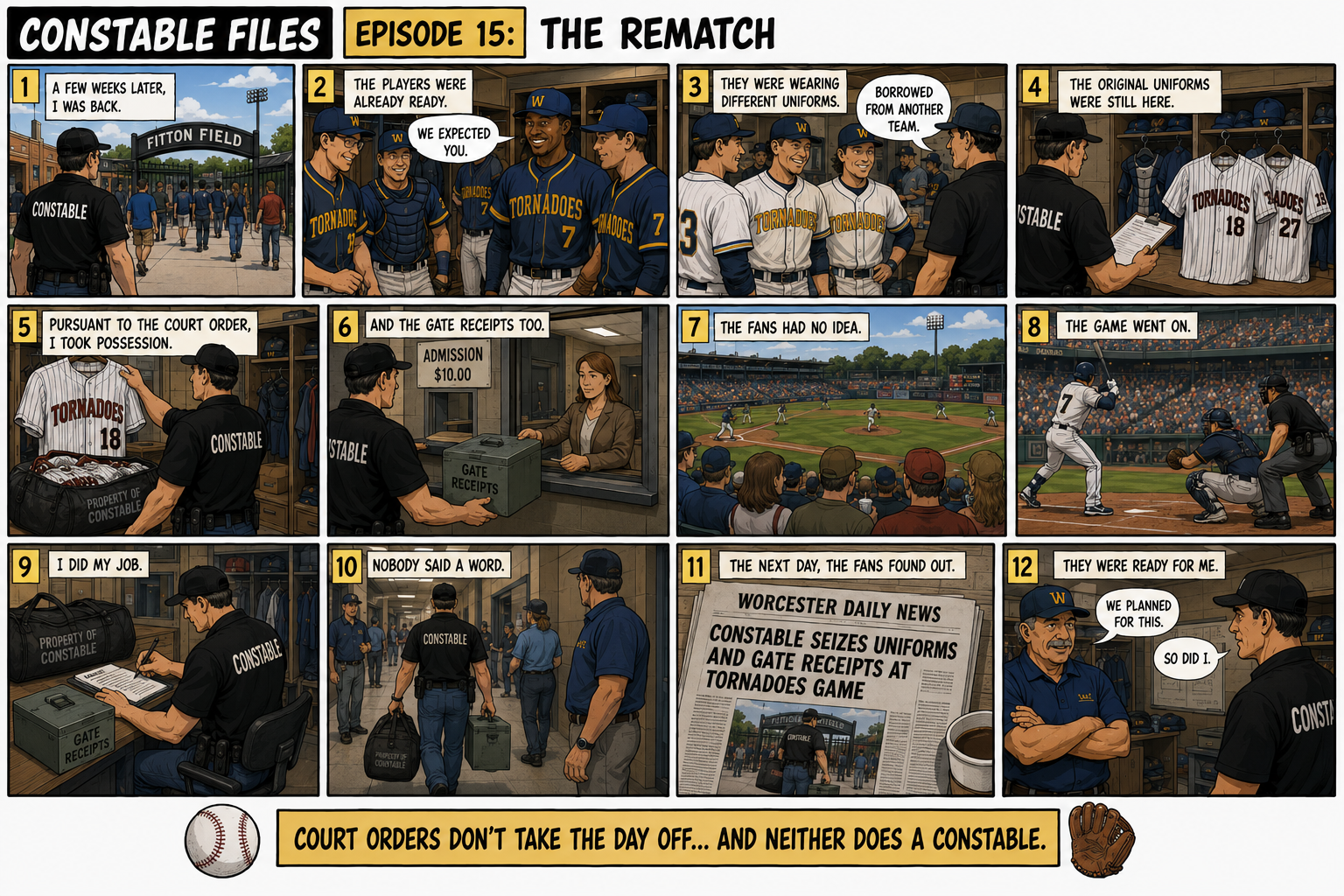
Getting served at a ballgame should have been the end of the story. It wasn't. When Alan crosses paths with the same team again, an already memorable service turns into an unexpected rematch. Part 2 of 3
Open this case file
The ballgame started it. The rematch continued it. This is where the story finally ends. After multiple encounters and unexpected twists, Alan and his elusive subject meet one last time for the conclusion nobody saw coming. Part 3 of 3
Open this case file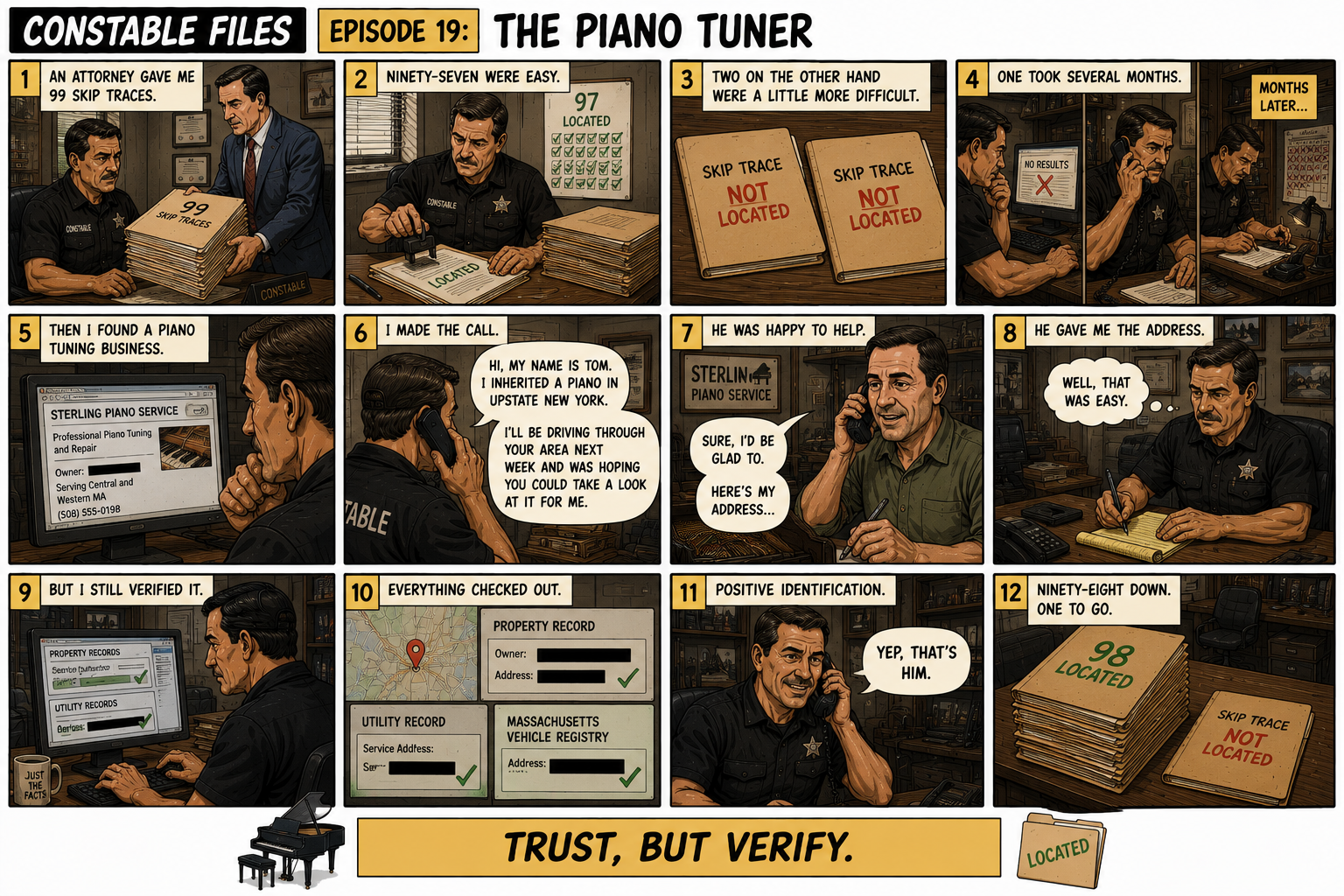
Ninety-seven skip traces were easy. The ninety-eighth seemed impossible. Then a piano tuner unknowingly helped solve a case that had been stalled for months.
Open this case file Hours into a commercial eviction, Alan needed a bathroom break. Instead, he stumbled onto the first clue that explained why the business looked more like an apartment than a dealership.
Open this case file
A husband hired Alan to serve divorce papers on his wife. The service went perfectly. Then the wife handed Alan a second set of divorce papers—with instructions to serve the husband.
Open this case file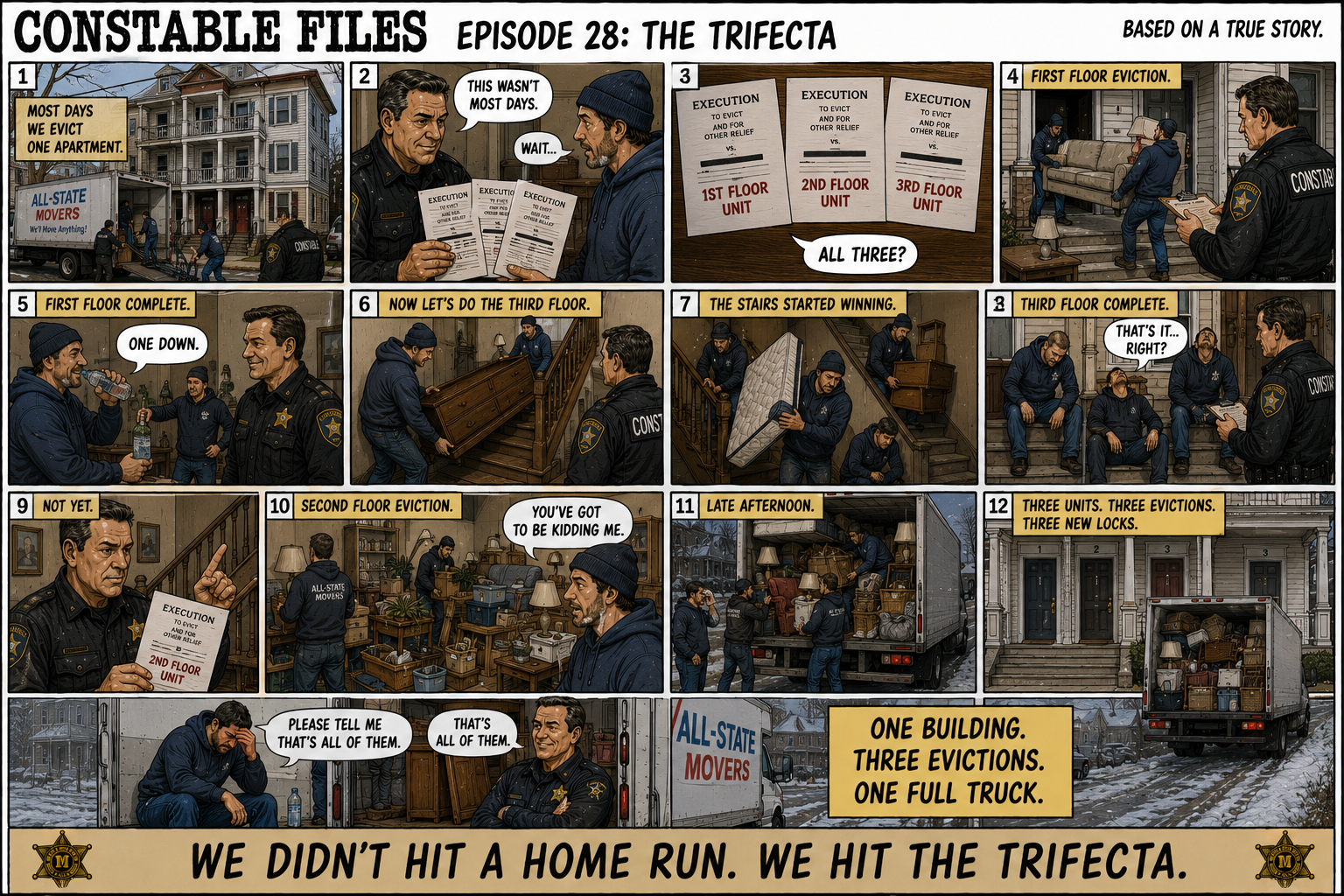
Most eviction days involve one apartment. This one involved three. When Alan arrived at a triple-decker and discovered executions for every unit in the building, everyone realized it was going to be a very long day.
Open this case file Some people challenge a foreclosure in court. Others try something more creative. This homeowner had a stack of homemade legal documents and complete confidence that he understood the law better than everyone else.
Open this case file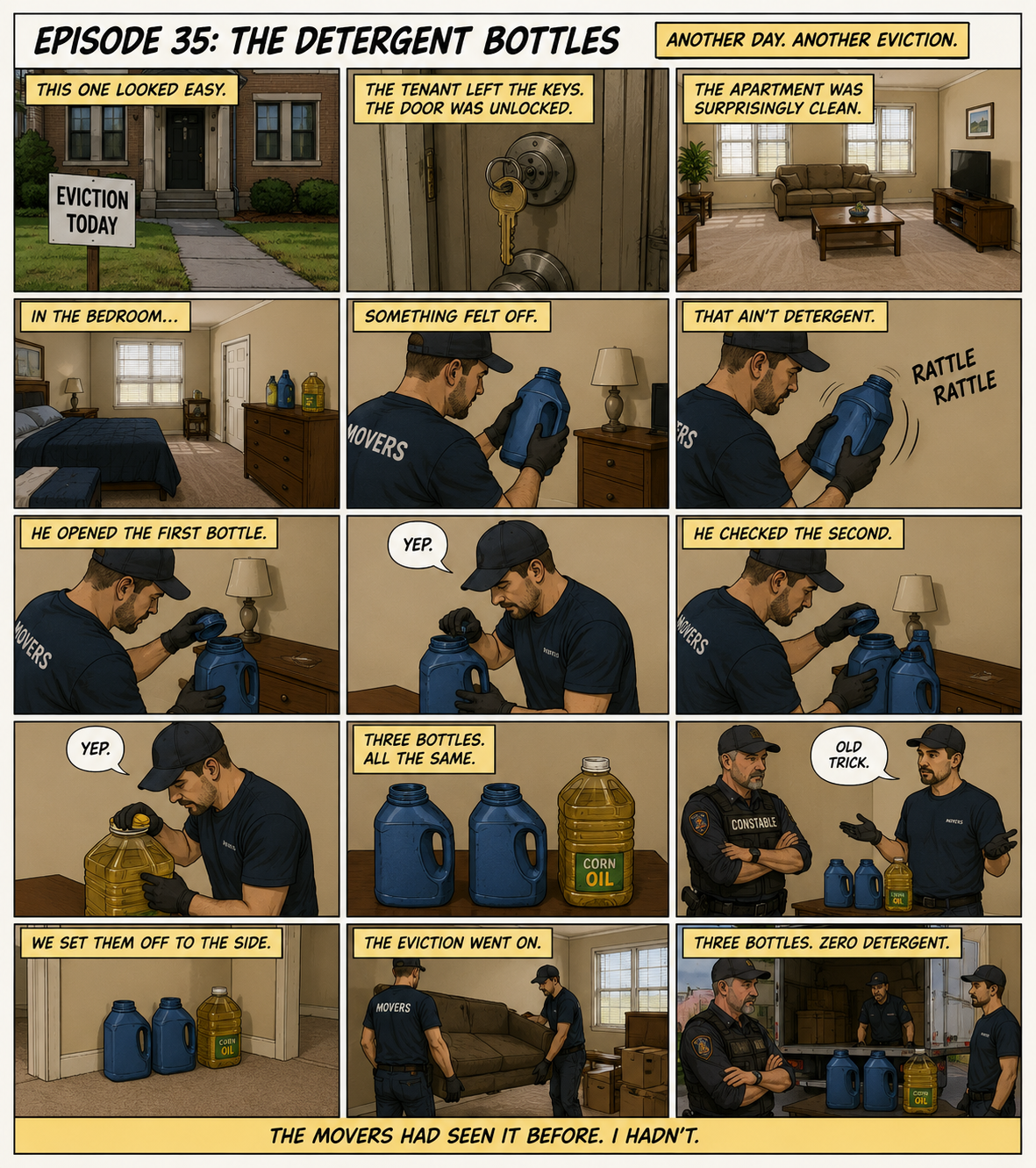
The apartment looked spotless. The tenant had even left the keys behind. Then a mover picked up a detergent bottle and heard something that detergent bottles aren't supposed to do.
Open this case file2 case files
Ninety-seven skip traces were easy. The ninety-eighth seemed impossible. Then a piano tuner unknowingly helped solve a case that had been stalled for months.
Open this case file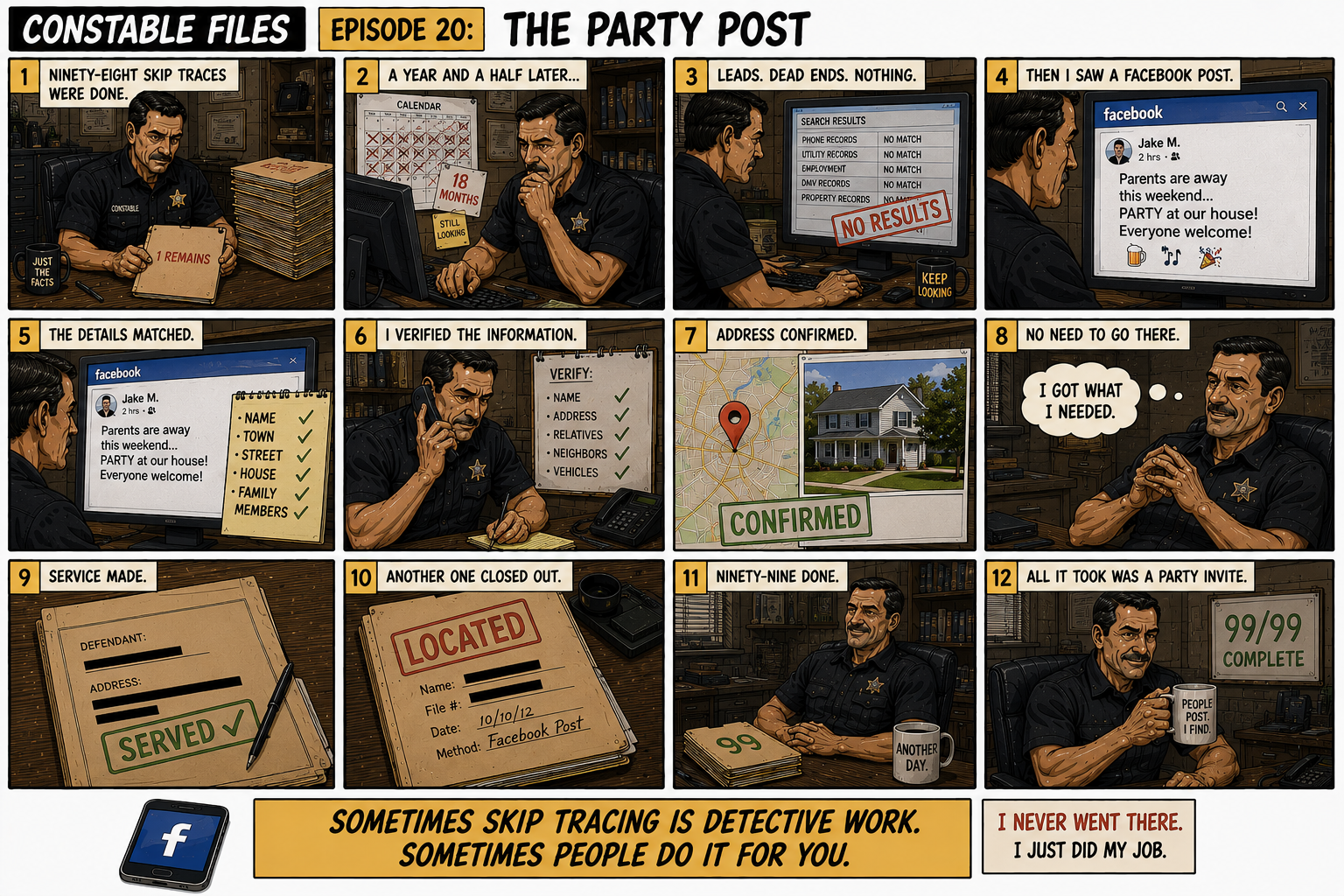
After a year and a half of dead ends, one elusive subject remained unfound. Then the subject did something many people do every day: they posted their plans on Facebook.
Open this case file1 case file
1 case file
3 case files
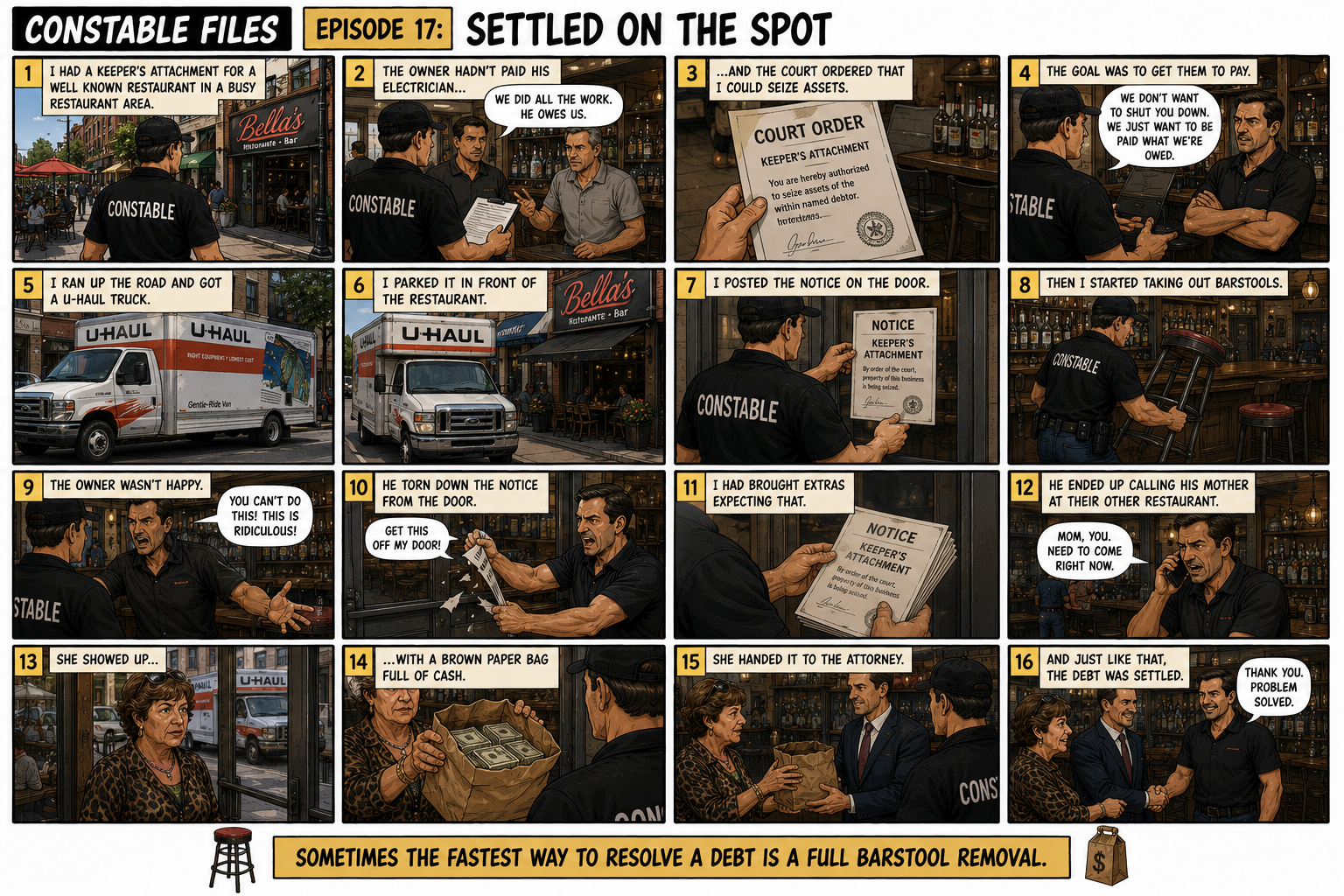
A keeper's attachment is designed to secure assets, not settle cases. But when Alan began removing property from a business, the reality of the situation suddenly became impossible to ignore.
Open this case file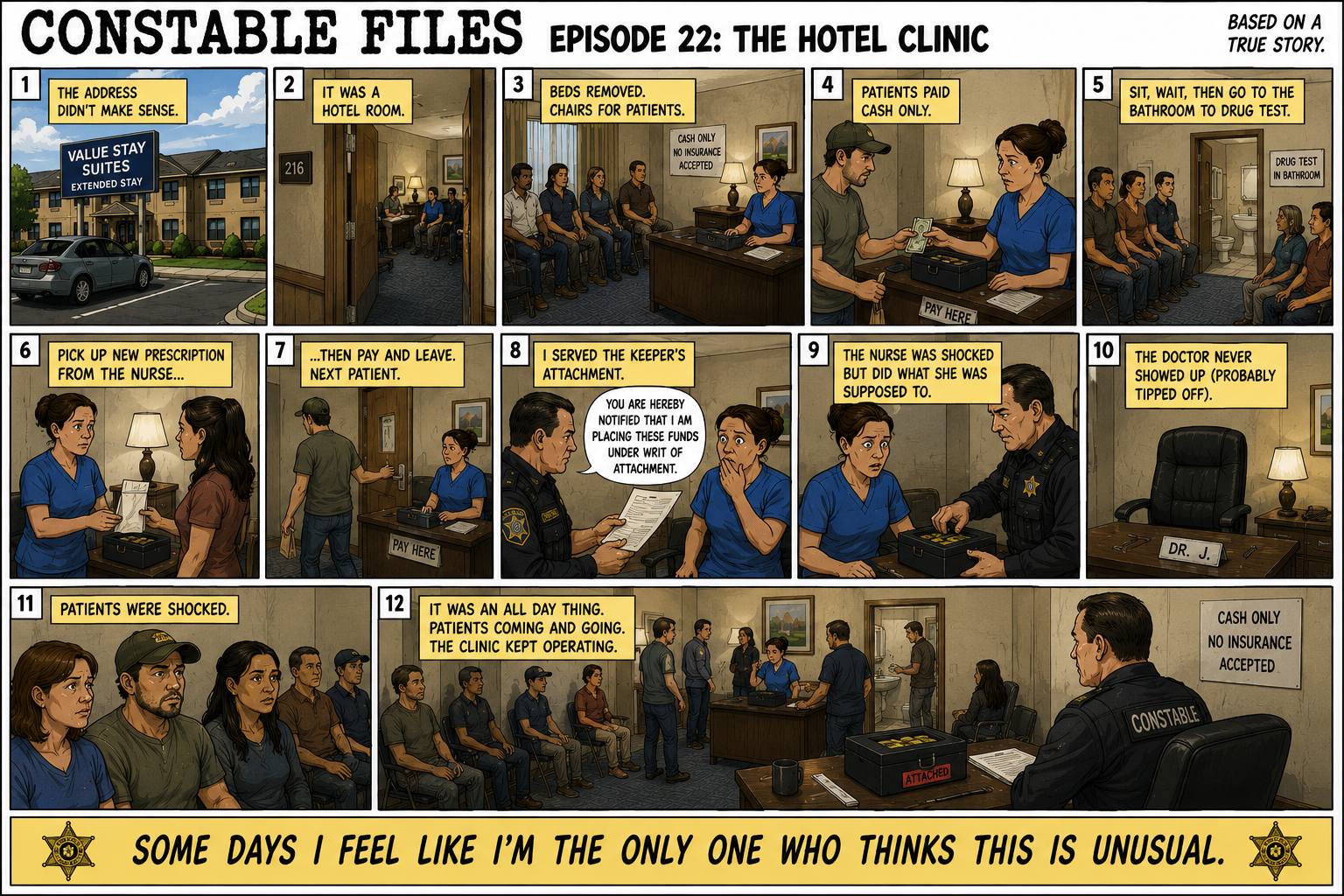
The address on the paperwork was a hotel room. That was odd enough. What Alan found inside was something nobody would have expected—a fully functioning medical clinic operating out of an extended-stay hotel.
Open this case file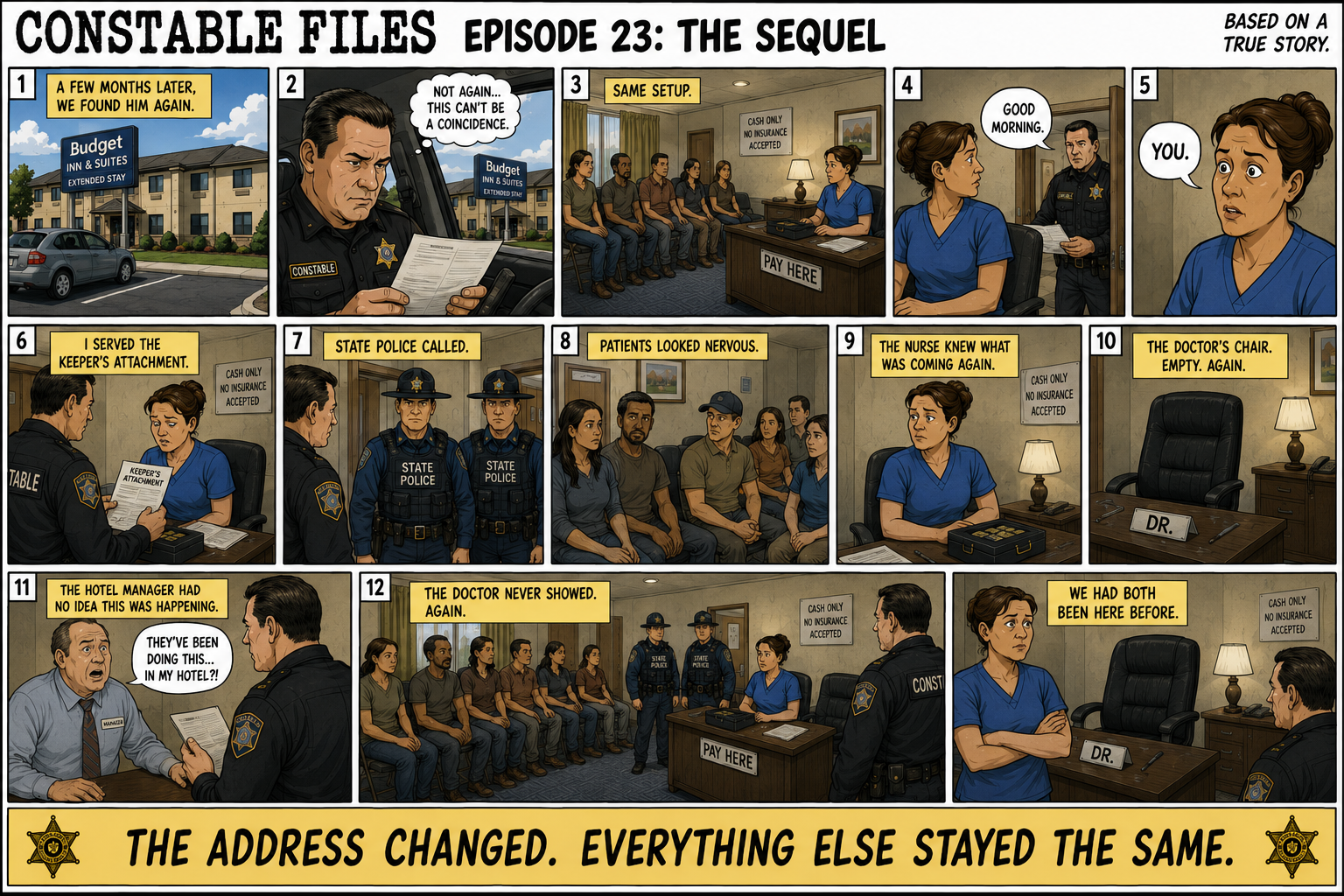
Most strange cases happen once. This one came back for a sequel. Months after the hotel clinic attachment, Alan found himself walking into the same operation at a different hotel—with the same nurse, the same patients, and the same empty doctor's chair.
Open this case file1 case file
1 case file
1 case file
1 case file
1 case file
2 case files
Getting served at a ballgame should have been the end of the story. It wasn't. When Alan crosses paths with the same team again, an already memorable service turns into an unexpected rematch. Part 2 of 3
Open this case file For months, a man ignored letters, phone calls, and every opportunity to resolve a court-issued capias. Then he decided to buy a house. Suddenly, returning Alan's call became a priority.
Open this case file6 case files
A routine service turns bizarre when a resident insists that the person Alan is looking for doesn't exist. The only problem? The evidence says otherwise. Sometimes the hardest part of serving papers isn't finding people—it's convincing others they're real.
Open this case file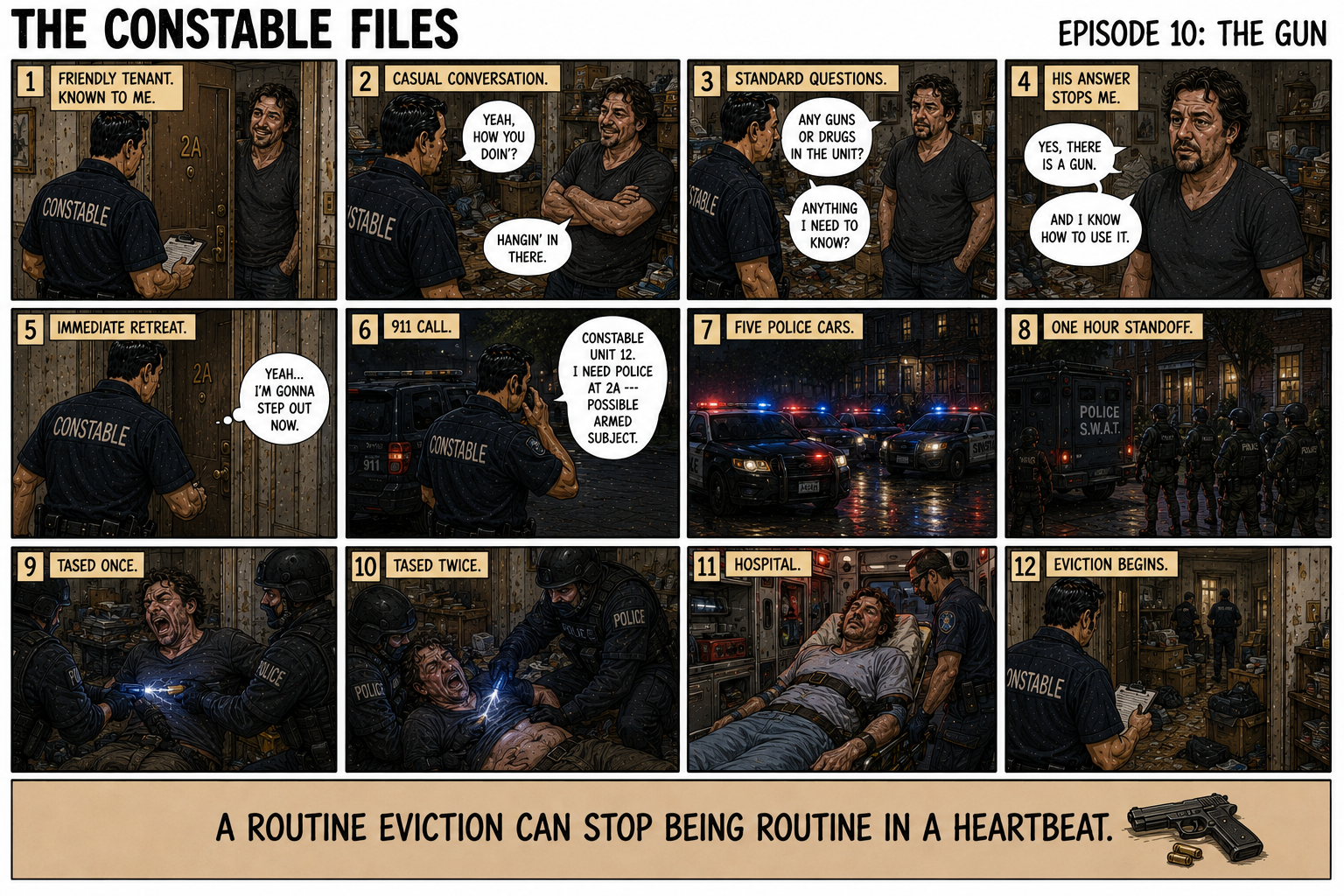
Serving papers is usually uneventful. Usually. During one routine service attempt, Alan suddenly found himself staring at something that instantly changed the tone of the encounter. What happened next would become a lasting lesson in staying calm under pressure.
Open this case file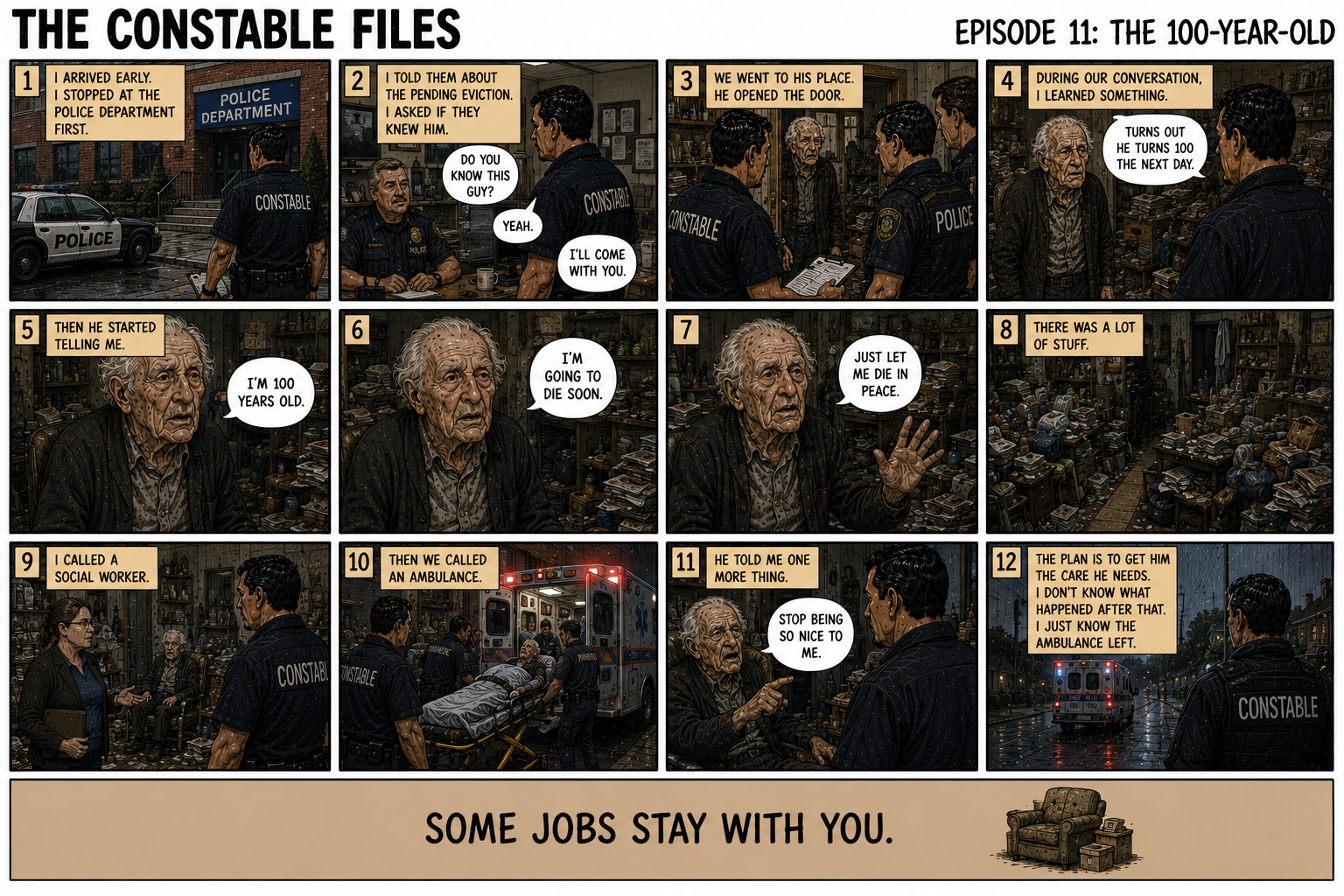
Most people Alan serves are having an ordinary day. This recipient had lived through an entire century. A routine service becomes an unforgettable encounter with someone whose life story stretched back further than most people can imagine.
Open this case file The eviction was routine. The bag was not. When a business owner became unusually desperate to retrieve one specific item, Alan began to suspect there was a reason—and he was right.
Open this case file
A court order, a photograph, and a matching description should have made this an easy recovery. Instead, it turned into an hour-long argument, three police officers, and one very stubborn shed.
Open this case file
A routine service attempt took an unexpected turn when the door was answered by a six-year-old boy who said he was home alone—and taking care of his toddler sister.
Open this case file1 case file
1 case file
2 case files
What started as a training-day eviction quickly became one of the strangest jobs Alan had ever handled. Just when everyone thought it was over, the tenants found a way to turn one eviction into two.
Open this case file
The tenants were gone, the heat was cranked to tropical levels, and every room was covered in cooked pasta. Years later, one question remains: why?
Open this case file1 case file
1 case file
1 case file
1 case file
1 case file
2 case files
Ninety-seven skip traces were easy. The ninety-eighth seemed impossible. Then a piano tuner unknowingly helped solve a case that had been stalled for months.
Open this case file After a year and a half of dead ends, one elusive subject remained unfound. Then the subject did something many people do every day: they posted their plans on Facebook.
Open this case file2 case files
A $70 invoice could have been paid with a single check. Instead, a year of broken promises turned it into a lesson about principles, persistence, and why you should never lie to Lance.
Open this case file A struggling young landlord needed help. Alan gave her every break he could. Years later, he learned that goodwill is not a substitute for payment.
Open this case file2 case files
The address on the paperwork was a hotel room. That was odd enough. What Alan found inside was something nobody would have expected—a fully functioning medical clinic operating out of an extended-stay hotel.
Open this case file Most strange cases happen once. This one came back for a sequel. Months after the hotel clinic attachment, Alan found himself walking into the same operation at a different hotel—with the same nurse, the same patients, and the same empty doctor's chair.
Open this case file1 case file
2 case files
A newly elected constable rode along for two evictions on the same day. One was easy. The other revealed the reality of the job—and an important lesson about how people should be treated.
Open this case file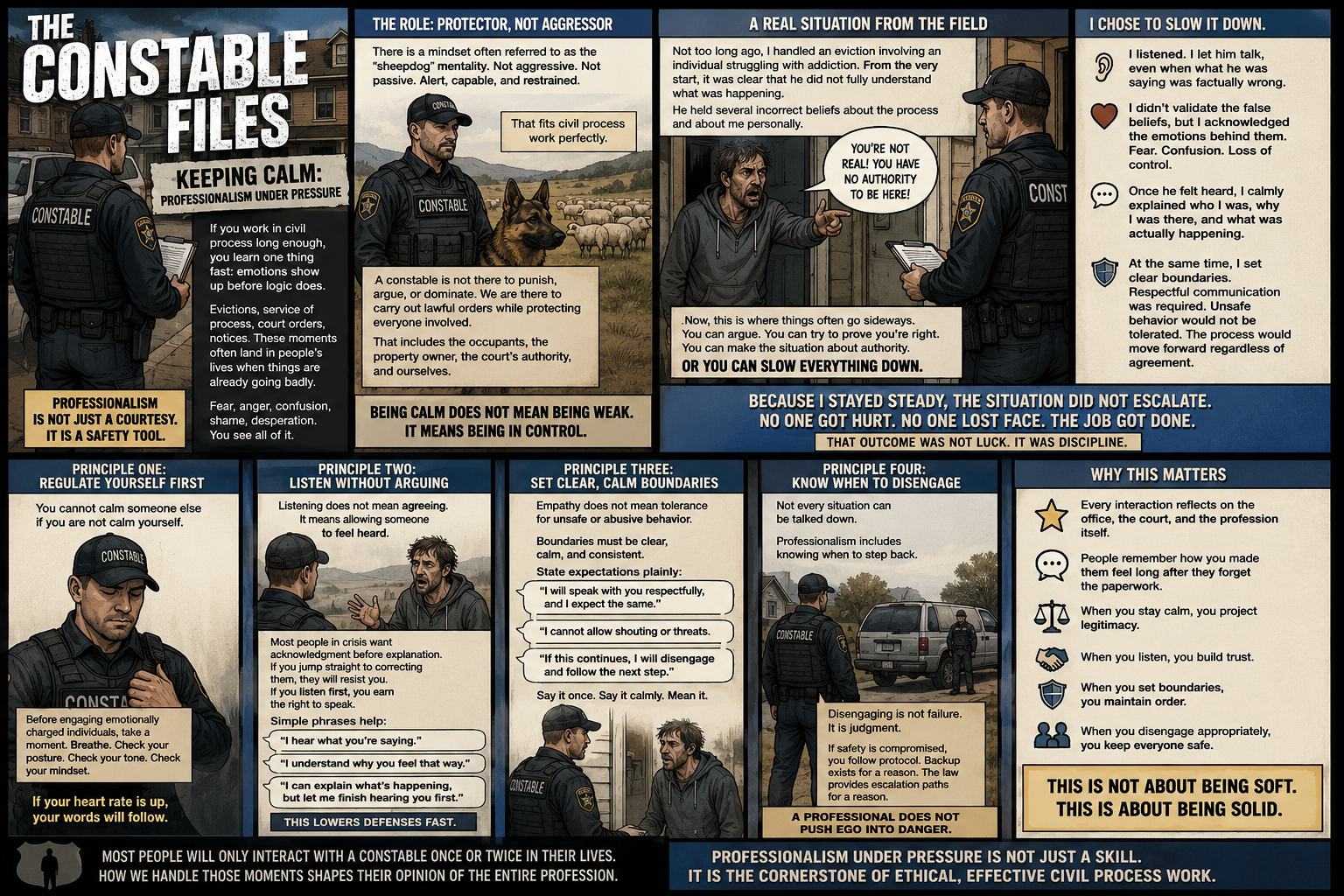
In civil process, staying calm is not weakness. It is control.
Open this case file1 case file
1 case file
1 case file