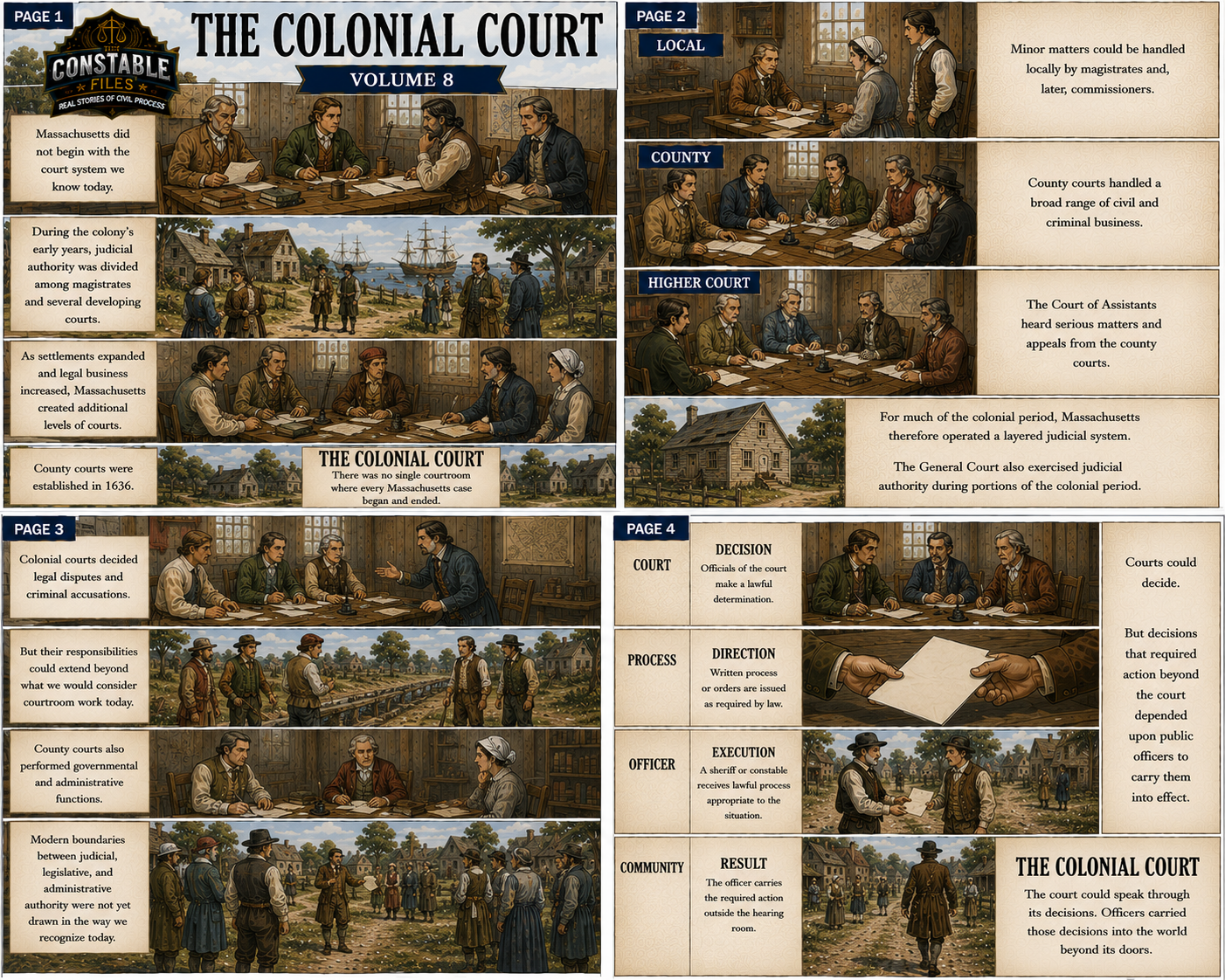
There was no single courtroom where every Massachusetts case began and ended. Colonial Massachusetts developed a layered system of magistrates and courts, each exercising different kinds of authority. And unlike courts today, their work could extend beyond deciding cases into responsibilities involving government and community administration. In Volume 8: The Colonial Court, explore how this early judicial system worked, how authority moved through its different levels, and why sheriffs and constables were essential when a court's decision required action beyond its doors. The court could decide. Public officers carried those decisions into the community.
Massachusetts did not begin with anything resembling the court system we know today.
During the early years of Massachusetts Bay, judicial authority was divided among magistrates and a developing collection of courts. As settlements grew and legal business increased, that system expanded. County courts were established in 1636, adding another important layer to colonial government.
Volume 8 of Before the Badge steps inside that developing judicial system.
Minor matters could be handled locally by individual magistrates and, later, commissioners. County courts exercised broad civil and criminal jurisdiction, while the Court of Assistants heard serious matters and appeals from the county courts. The General Court also exercised judicial authority during portions of the colonial era.
But understanding the colonial courts requires abandoning another modern assumption: courts did more than conduct trials.
County courts also exercised governmental and administrative responsibilities, including matters involving public works. The clear boundaries we now expect between judicial, legislative, and administrative authority had not yet developed in the same way.
That makes the colonial court an important piece of the larger story told throughout Before the Badge. A court could make a lawful determination, but when that decision required something to happen outside the hearing room, someone still had to carry it into effect.
Depending upon the matter, that could involve a sheriff, a constable, or another public officer.
The relationship was not simply a chain of command. It was a developing system in which different offices performed different functions:
COURT → DECISION
PROCESS → DIRECTION
OFFICER → EXECUTION
COMMUNITY → RESULT
The colonial judicial system would continue to change, particularly with the establishment of provincial government after 1692. But the fundamental problem remained remarkably practical: a decision made inside a court meant little if it could not be carried into the world outside.
The court could speak through its decisions. Officers carried those decisions into the world beyond its doors.
Before the Badge is a historical mini-series from The Constable Files, exploring the history and evolution of the Massachusetts constable.