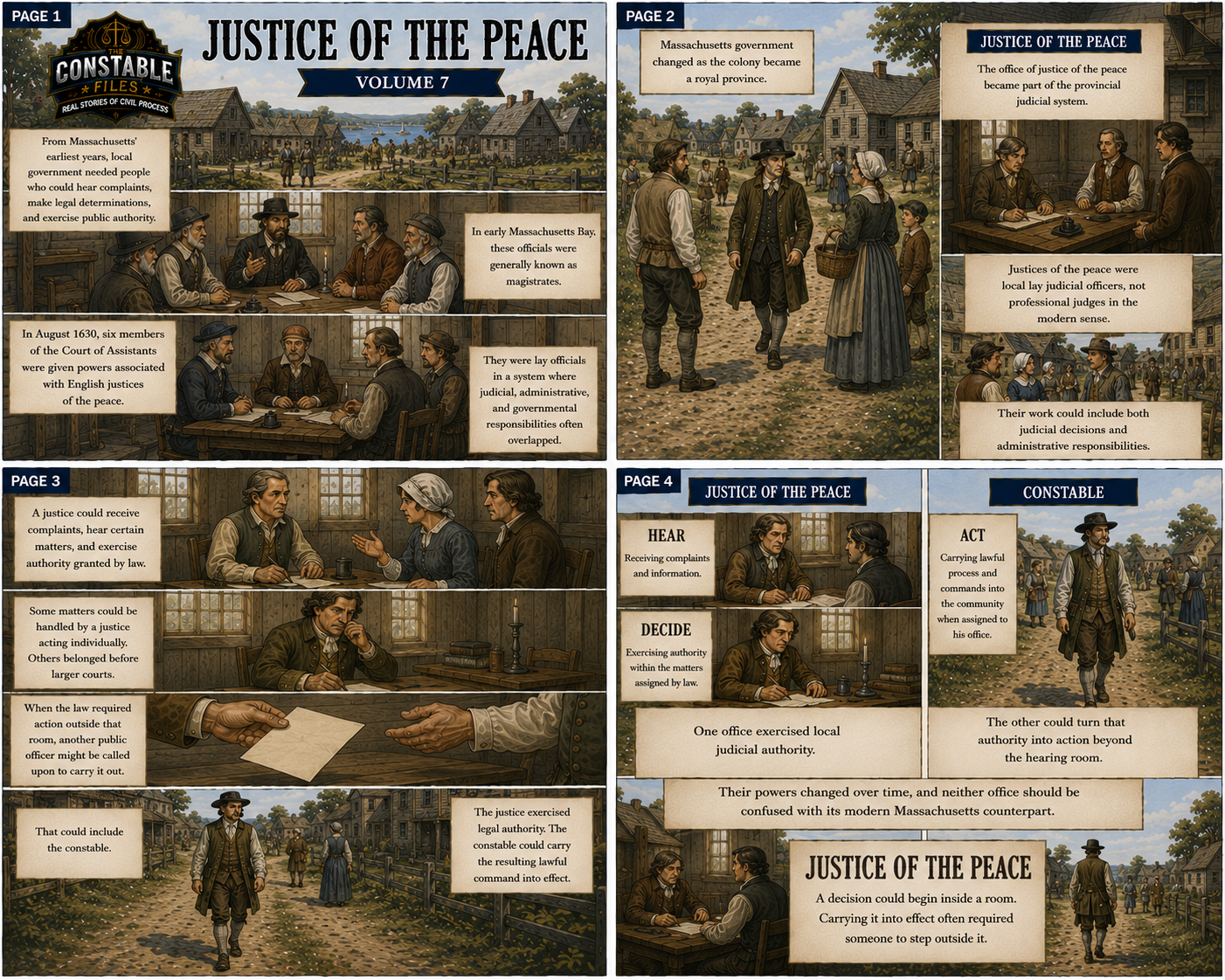
Before an order could be carried into the community, someone had to exercise the legal authority behind it. From the magistrates of early Massachusetts Bay to the justices of the peace of the provincial era, local lay officials played an important role in administering justice. They heard complaints, made legal determinations, and exercised powers assigned to them by law. In Volume 7: Justice of the Peace, discover how this local judicial office developed, how it differed from the modern judge, and how its work could intersect with that of the constable. A decision could begin inside a room. Carrying it into effect often required someone to step outside it.
Who stood on the other side of the legal process carried into the community by constables?
The answer changed as Massachusetts government developed.
In the earliest years of Massachusetts Bay, local judicial authority was exercised by officials generally known as magistrates. In 1630, members of the Court of Assistants were granted powers associated with English justices of the peace. As Massachusetts later developed into a royal province, the recognizable office of justice of the peace became part of its judicial system.
Volume 7 of Before the Badge explores that transition and the relationship between local judicial authority and the constable.
These officials should not be confused with modern professional judges. Colonial magistrates and justices of the peace were generally lay officials operating in a governmental system where judicial and administrative responsibilities could overlap. Depending upon the period and the authority granted by law, they could receive complaints, hear certain matters, make legal determinations, and perform other public duties.
Their relationship with the constable was equally important, but it was not a modern chain of command. A justice was not simply the constable's boss, nor did every constable action originate with a justice of the peace. When a lawful decision required action outside the hearing room, however, a public officer could be called upon to carry it into effect.
That officer could be the constable.
Justice of the Peace therefore adds another piece to the system developing throughout Before the Badge:
HEAR → DECIDE → ACT
One office exercised local judicial authority. Another could carry the resulting lawful process or command into the community.
A decision could begin inside a room. Carrying it into effect often required someone to step outside it.
Before the Badge is a historical mini-series from The Constable Files, exploring the history and evolution of the Massachusetts constable.